Blessed Virgin Mary of Loreto: the complete story
The Sanctuary of the Holy House is located in Loreto (AN): it is a popular pilgrimage site where Catholics venerate the Virgen Lauretana (Virgin of Loreto).
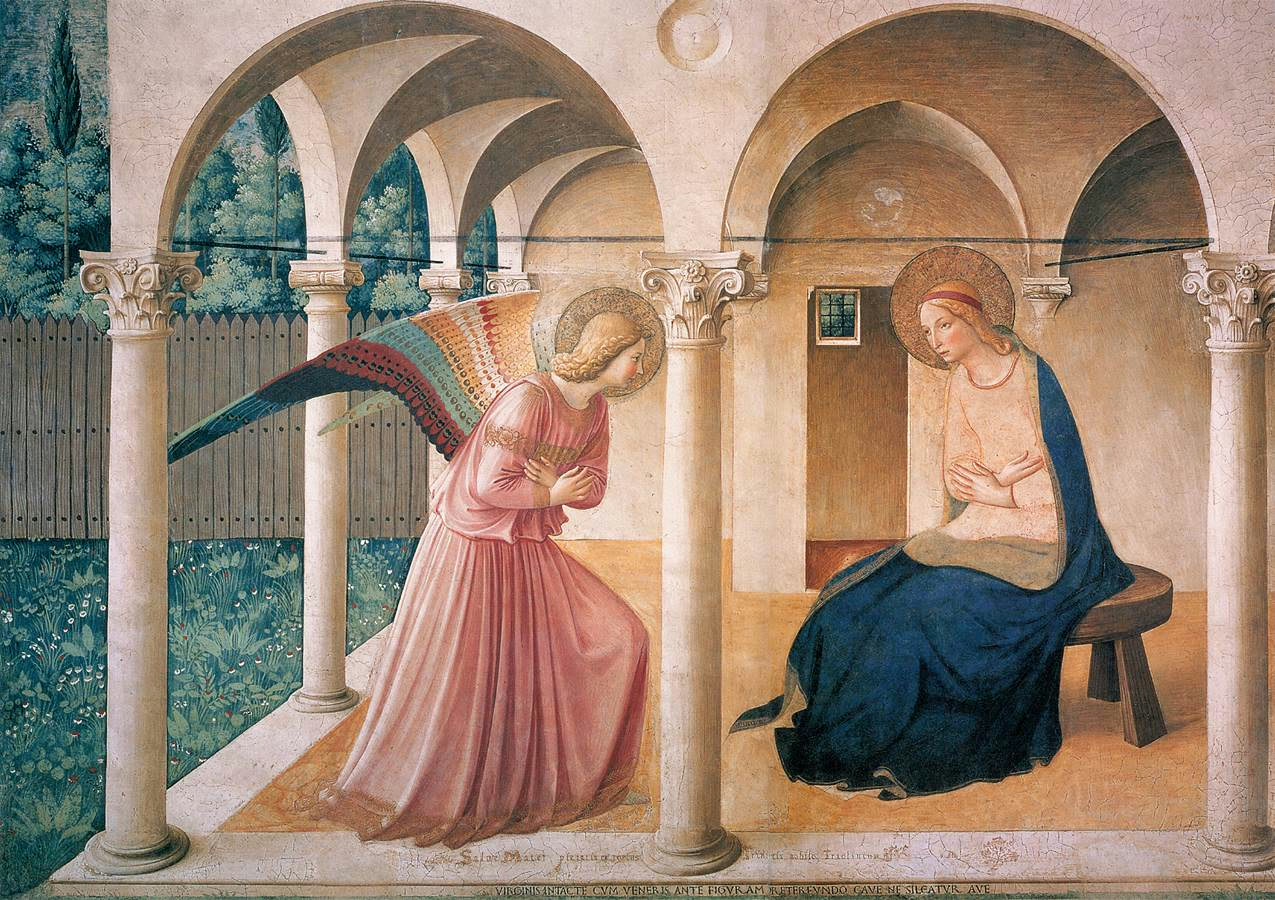
It is the most important Marian sanctuary in Italy; inside it is kept the Holy House of Nazareth where, according to devotional tradition, the Virgin Mary received the Annunciation.
Saint John Paul II
Blessed John Paul II (Karol Józef Wojtyła, 1978-2005), referring to the Holy House of Loreto, made the following reflection:
« The one at Loreto is a wonderful Sanctuary. The thirty-year experience of sharing, which Jesus had with Mary and Joseph, is inscribed within it. Through this human and divine mystery, the history of all men is somehow inscribed in the house of Nazareth, because every man is linked to a “house”, where he is born, works, rests, meets others, and the history of every man is marked in a particular way by a house: the house of his childhood, of his first steps in life.
And it is eloquent and important for everyone that this unique and singular Man, who is the only begotten Son of God, also wished to link his history to a house, that of Nazareth, which according to the Gospel account, hosted Jesus of Nazareth throughout the entire span of his childhood, adolescence and youth, that is, of his mysterious human maturation […]. The house of the Son of Man is therefore the universal house of all the adopted children of God. The history of every man, in a certain sense, passes through that house […].»
The “House of the Madonna” was formed by three walls leaning against a grotto carved into the rock (which is located in the Basilica of the Annunciation in Nazareth). Popular tradition recounts that on the night between December 9 and 10, 1294, the stones of the house of Nazareth were transported by angels in flight. In reality, some studies and rediscovered documents have confirmed that the transport took place by sea on Crusader ships.
In fact, after the expulsion of Christians from the Holy Land by the Muslims, a member of the Angeli family, who ruled Epirus (a region in northwestern Greece), took an interest in saving the Holy House from certain ruin, and it was therefore transported first to Tersatto (today’s Croatia) in 1291, and then to Loreto on December 10, 1294.
Since the beginning of the 14th century, it was already a destination for pilgrimage, even for those who, taking the coastal road, were headed to S. Michele al Gargano or the Holy Land; the flow became enormous in the 15th and 16th centuries, leading Pope Leo X, in 1520, to equate the vow of the pilgrims of the Sanctuary of Loreto to that of Jerusalem, which Loreto had gradually replaced at the peak of the great penitential pilgrimages, which included Rome, Santiago de Compostela, and Jerusalem.
Wonder
The striking wonder of the translation of the Holy House also attracted, starting from the 15th century, the pilgrimage of kings and queens, princes, cardinals, and popes, who left gifts or ex-votos for graces received; subsequently, they were joined by leaders, poets, writers, inventors, founders of religious Orders, philosophers, artists, and over 200 future saints and blesseds.
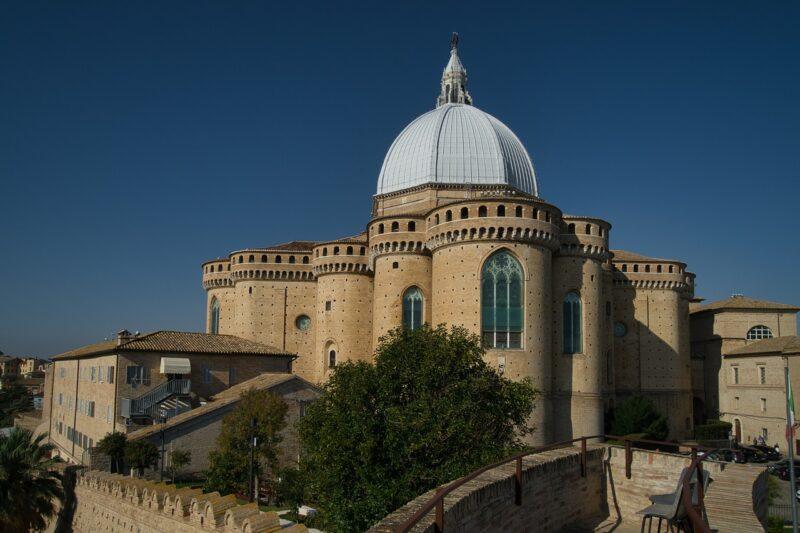
Studies carried out on the stones of the Holy House confirm their Palestinian origin; they are worked according to the technique used by the Nabataeans, a people bordering the Jews, also widely used in Palestine. On the stones there are numerous graffiti similar to those Judeo-Christian ones of the 2nd-5th century found in the Holy Land, particularly in Nazareth. The sanctuary was built to protect the Holy House, on the initiative of the bishop of Recanati, Nicolò delle Aste, in 1469 and was completed in 1587.
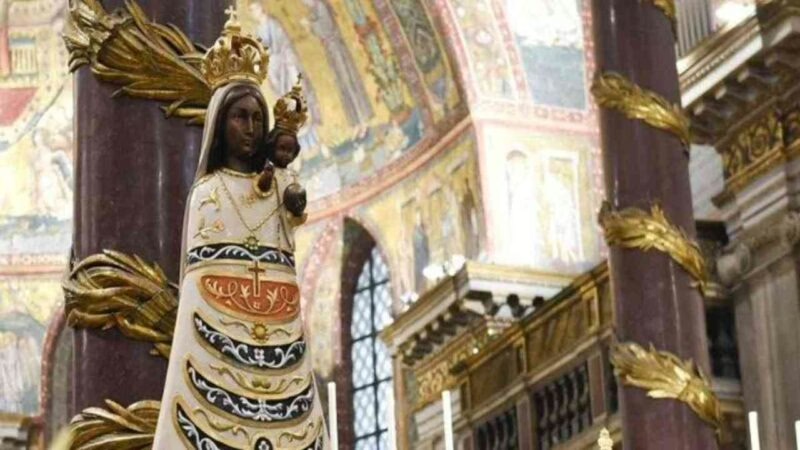
Virgin of Loreto
Inside the Holy House is the statue of the Virgin of Loreto, sculpted from wood of a cedar of Lebanon from the Vatican Gardens, which replaces the one from the 14th century destroyed in a fire that broke out in the Holy House in 1921. It was commissioned by Pope Pius XI (1922-1939) who crowned it in the Vatican in 1922 and had it solemnly transported to Loreto. It was modeled by Enrico Quattrini and executed and painted by Leopoldo Celani. Since the 16th century, it has been covered with a mantle, called the “dalmatic”.
Over 50 popes have made pilgrimages to Loreto and their devotion has always been great. Popes Pius II (1458-1464) and Paul II (1464-1471) turned to the Virgin to miraculously recover from their serious illnesses.
Pope Benedict XV (1914-1922), considering the translation of the Holy House, from Palestine to Loreto, proclaimed her the patron saint of aviators.
Finally, the “Litanie Lauretane” (Litany of Loreto) should be remembered, which since the 12th century have become a true prayer to the Virgin, centered on the titles that have been attributed to her throughout time, including biblical references. The “Litanie Lauretane” replaced in Christianity the ones called “veneziane” (Venetian) (in use in the basilica of S. Marco and originating from Aquileia) and the “deprecatorie” (deprecatory) (i.e., of supplication, originating from Germany).
LITANY OF LORETO
Lord, have mercy
Christ, have mercy
Lord, have mercy.
Christ, hear us.
Christ, graciously hear us.
God, the Father of Heaven,
Have mercy on us.
God, the Son, Redeemer of the world,
God, the Holy Ghost,
Holy Trinity, one God,
Holy Mary,
Pray for us.
Holy Mother of God,
Holy Virgin of virgins,
Mother of Christ,
Mother of the Church,
Mother of Divine Grace,
Mother most pure,
Mother most chaste,
Mother inviolate,
Mother undefiled,
Mother most amiable,
Mother most admirable,
Mother of good counsel,
Mother of our Creator,
Mother of our Savior,
Mother of mercy,
Virgin most prudent,
Virgin most venerable,
Virgin most renowned,
Virgin most powerful,
Virgin most merciful,
Virgin most faithful,
Mirror of justice,
Seat of wisdom,
Cause of our joy,
Spiritual vessel,
Vessel of honor,
Singular vessel of devotion,
Mystical Rose,
Tower of David,
Tower of ivory,
House of gold,
Ark of the covenant,
Gate of Heaven,
Morning Star,
Health of the sick,
Refuge of sinners,
Comforter of the afflicted,
Help of Christians,
Queen of Angels,
Queen of Patriarchs,
Queen of Prophets,
Queen of Apostles,
Queen of Martyrs,
Queen of Confessors,
Queen of Virgins,
Queen of all Saints,
Queen conceived without original sin,
Queen assumed into Heaven,
Queen of the most holy Rosary,
Queen of families,
Queen of peace.
Lamb of God, who takest away the sins of the world,
Spare us, O Lord.
Lamb of God, who takest away the sins of the world,
Graciously hear us, O Lord.
Lamb of God, who takest away the sins of the world,
Have mercy on us.
Pray for us, O Holy Mother of God.
That we may be made worthy of the promises of Christ.
Let us pray.
Grant, we beseech Thee, O Lord God,
that we, Thy servants,
may always enjoy health of soul and body,
and by the glorious intercession
of the Blessed Virgin Mary, ever-virgin,
deliver us from present sorrow,
and bring us to eternal joy.
Through Christ our Lord.
Amen.