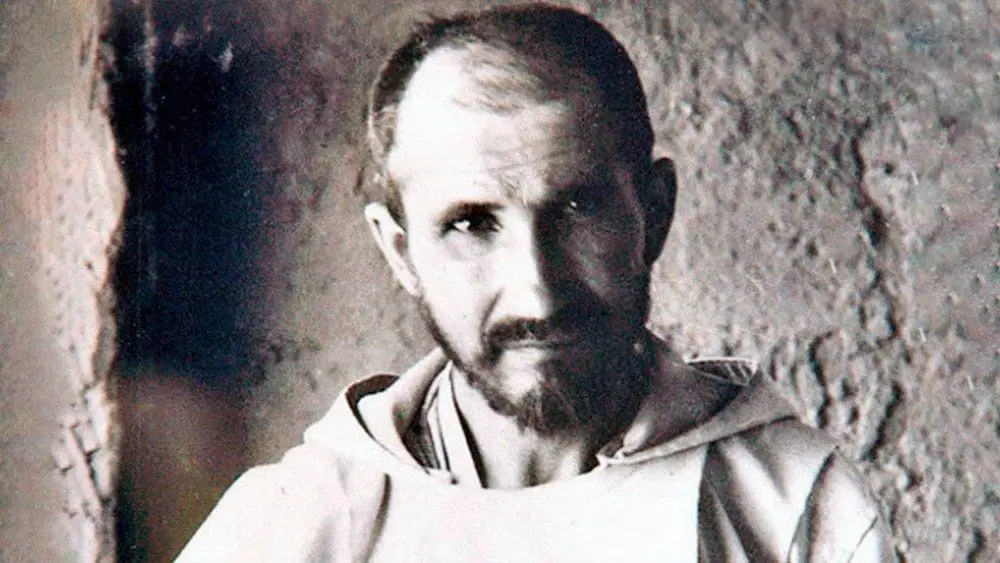

Read the Story of Saint Charles de Foucauld
Charles of Jesus, originally Charles de Foucauld, was born in Strasbourg (F) on September 15, 1858. Orphaned at the age of six, he was raised by his grandfather who, with kindness and generosity, instilled in him a love for family and country, a passion for study, and for the silence of nature.
In 1876, he enlisted in the army, where he completed his studies at the Cavalry Academy and also pursued a brief career. After being discharged, he undertook a dangerous exploration in Morocco (1883-1884).
The expedition proved to be a scientific event of such importance that it earned him the gold medal of the Geographical Society. But success did not quiet his spirit. He wrote: “I started going to church, without believing, feeling good only there and spending long hours repeating this strange prayer: My God, if you exist, make me know You ”.
Returning to France, moved by the discreet and affectionate welcome of his deeply Christian family, he began a search and asked a priest to instruct him. Guided by Father Huvelin, he rediscovered God in October 1886: “ As soon as I believed there was a God, I understood that I could do nothing but live for Him alone ”.
A pilgrimage to the Holy Land revealed his vocation: to follow and imitate Jesus in the life of Nazareth. He lived 7 years at La Trappe, first at Notre-Dame des Neiges, then at Akbès in Syria. Later, he lived alone, in prayer, adoration, and great poverty, near the Poor Clares of Nazareth.
Ordained a priest at 43 (1901), in the Diocese of Viviers, he went to the Algerian Sahara desert, first to Beni Abbès, poor among the poorest, then further south to Tamanrasset with the Tuaregs of the Hoggar. He lived a life of prayer, continually meditating on the Sacred Scripture, and of adoration, with the unceasing desire to be, for every person, the “universal brother”, a living image of the Love of Jesus. “I would like to be good – he used to say – so that one might say: If such is the servant, what must the Master be like?”.
The Berbers called him “marabut“,which in the Maghreb lexicon refers to the “holy man“, the hermit.
Sharing their life, he learned their language, translated their poems, and published an impressive illustrated dictionary. Around him arose the community of the Little Brothers of Jesus, a religious family centered on the Gospel, the Eucharist, and the apostolic life.
Father de Foucauld’s spiritual writings aim to reveal to himself and to everyone the intimate relationship of faith with Christ; a faith that cannot be nourished only by the breath of the moment, but must find its strong and secure rock in the known and investigated Christian truths.
“Faith is what makes us believe from the bottom of our soul all the dogmas of religion, all the truths that religion teaches us, consequently the content of the Sacred Scripture, and all the teachings of the Gospel: in a word, everything that is proposed to us by the Church…”.
Charles de Foucauld died on the evening of December 1, 1916, struck by a bullet, during a skirmish incited by rebels of the Hoggar.
His dream was always to share his vocation with others: after writing several rules of religious life, he thought that this “Life of Nazareth” could be lived by everyone and everywhere.
In 1968, several congregations inspired by Father de Foucauld were approved by the Holy See. Today, the “Spiritual Family of Charles de Foucauld” gathers all the Catholic religious communities inspired by the Saint. They number, in total, about 13,000 members.
They have similar aims but gather different categories of people (priests, laypeople, religious). They do not constitute a single congregation but are only linked by common spiritual references and bonds of fraternity.
The Family includes 11 Religious Congregations and 8 Associations of Spiritual Life:
Religious Congregations
- Little Sisters of the Sacred Heart
- Fraternity of the Little Sisters of Jesus
- Little Sisters of the Gospel
- Little Sisters of Nazareth
- Little Sisters of the Sacred Heart of Jesus
- Little Brothers of Jesus
- Little Brothers of the Gospel
- Little Brothers of the Incarnation
- Little Sisters of the Incarnation
- Little Brothers of the Cross
- Little Brothers of Jesus Caritas
- Associations of Spiritual Life
- Priestly Fraternity Jesus Caritas
- Fraternity Jesus Caritas
- Fraternity Charles de Foucauld
- Secular Fraternity Charles de Foucauld
- Union Sodalité Charles de Foucauld
- Group Charles de Foucauld
- Community of Jesus
- Institute of Brother Servants
Charles de Foucauld was beatified in Saint Peter’s on November 13, 2005, under the pontificate of Pope Benedict XVI and canonized in Saint Peter’s on May 15, 2022, under the pontificate of Pope Francis.
Meaning of the name Charles: “strong, virile, free” (archaic German).
For more details:
fonte © vangelodelgiorno.org
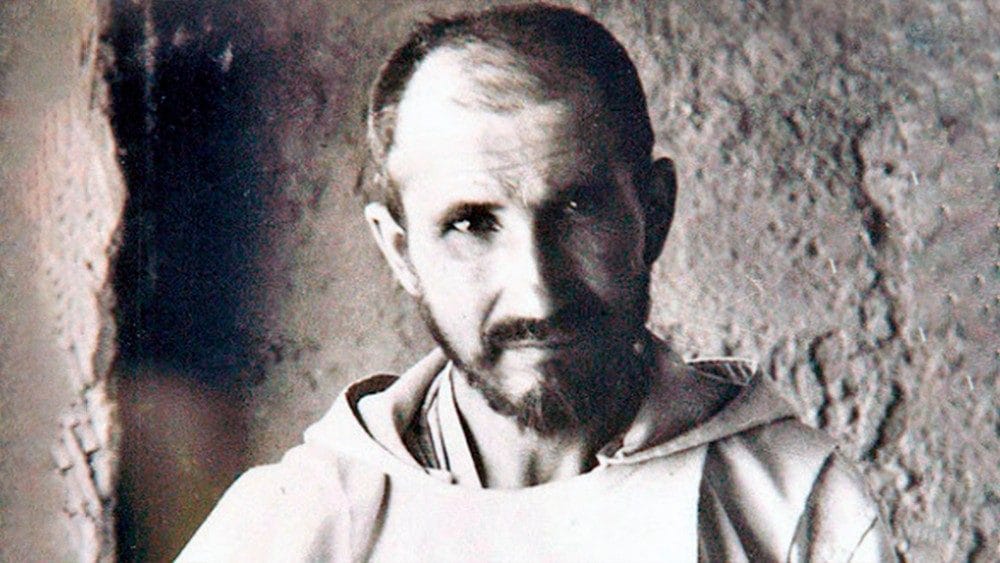
A young Frenchman, rich and aristocratic, he gave up everything to live in the Algerian desert, a silent witness of Christ through the presence of the sacrament of the Eucharist and closeness to the most abandoned brothers. He was assassinated in 1916.
A Rich Young Man
Charles de Foucauld (1858-1916), a rich, aristocratic young Frenchman who had lost his parents as a child and his faith in adolescence, was a young cadet at the prestigious Saint-Cyr military academy and enjoyed life to the fullest. Or perhaps, not so dissimilar to that rich young man who ran to Jesus to ask what he should do to inherit eternal life (cf. Mark 10:17-22), he felt an inexplicable void that he sought to fill with the pleasures of the world. A fellow student recalls: “If you have never seen Foucauld in this room, reclining with indolence in a comfortable armchair while savoring a tasty snack of pâté de foie gras washed down with fine champagne, then you have never seen a man enjoying life”.
After graduating, Charles embarked on a military mission and a geographical expedition to Algeria. Here, in the vast silence of the desert, among the nomads whose lifestyle was so different from his own, the void that the young soldier had sought to fill with the goods of this world began to make itself felt. A silent question arose in him, and he began to pray: “My God, if it is true that you exist, let me know you”.
“Go … sell everything … come”
In 1886, upon his return to France, the 28-year-old confided his inner torment to a priest, who suggested he go to confession—which he did. Faith came—and with it, the demands. “Go … sell everything … come”: this is what Jesus says to the young man in the Gospel, whom He looks upon with love. Charles felt Jesus’ gaze rest upon him in the same unexpected and unpredictable way it had happened to that other rich young man some 2000 years earlier. He knew he was called to respond to that love with his life.
But at this point, the stories of these two rich young men diverge: the young man in the Gospel goes away sad, unable to part with his possessions. Charles, instead, writes: “The moment I began to believe that there is a God, I understood that I could do nothing but live for Him alone”. So he went, sold, and left—first to the Trappist monasteries in France and Syria. After completing his studies for the priesthood and receiving ordination in France, he felt the call to return to the desert. In the Sahara, he lived the simple and austere life of a hermit among the Tuareg nomads. He wanted to be an adorer in the desert, “brother to the most abandoned”.
Father Charles wanted to evangelize, “not by word but through the presence of the Blessed Sacrament, through prayer and penance and fraternal and universal love”. In notes written to those brothers with whom he hoped to share his life, but which he never actualized, he wrote: “Our whole existence should shout the Gospel”.
Shouting the Gospel
In 1916, Father Charles was assassinated by bandits. His life and his solitary death were a strong “shout” that the one God, merciful and benevolent, is the origin and the end of all love. This brother in the desert embodies that great “confession” described by Pope John Paul II as the essence of every consecrated life. Through a “profound configuration with the mystery of Christ,” the Pope wrote in the Apostolic Exhortation Vita Consecrata, “consecrated life carries with it in a special way that confessio Trinitatis which is the mark of every Christian life; it acknowledges with wonder the sublime beauty of God, Father, Son and Holy Spirit, and joyfully bears witness to his loving concern for every human being”.
Father Charles’ “confession of the Trinity” was fruitful: after his death, in addition to that specific religious community he had desired, many other communities were born. In 2022, Pope Francis canonized the martyr Father Charles of Jesus, a rich young man who had sold everything he owned to follow the Lord.
fonte © Vatican News – Dicasterium pro Communicatione
🍝 La Pasta che fa bene al cuore
Partecipa alla Seconda Edizione del nostro evento di solidarietà.
Unisciti a noi per trasformare un piatto di pasta in un gesto d’amore ❤️