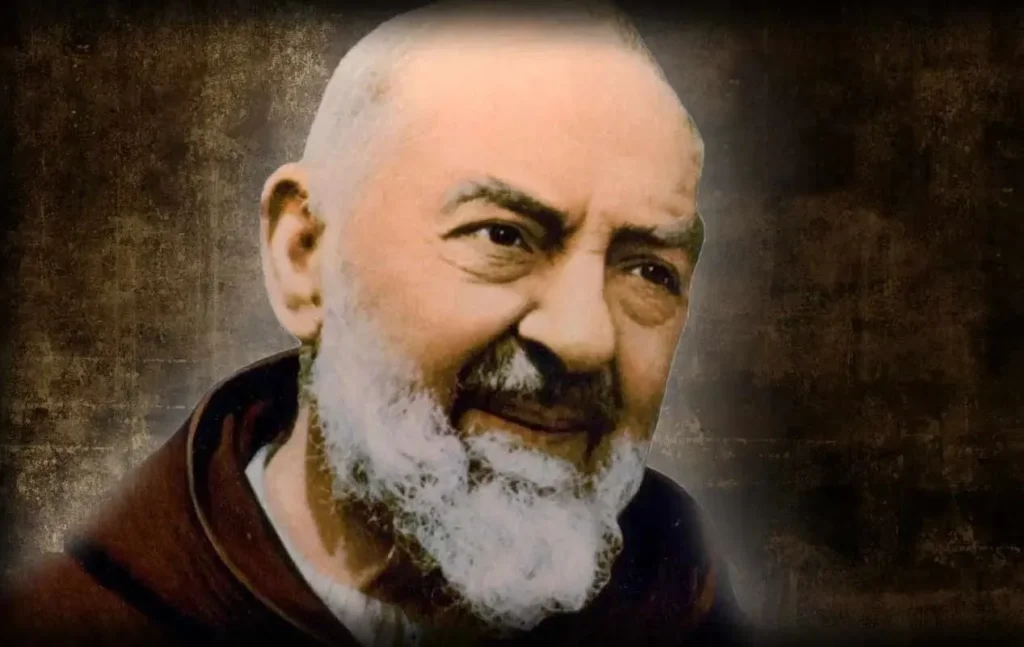

Saint Pio of Pietrelcina: The Complete Story
O.F.M. CAP. PRIEST (1887-1968)
Rivers of ink have been spilled around his figure. An incalculable number of articles and very many books: it is estimated that there are approximately more than 200 biographies dedicated to him in Italian alone. “I will make more noise dead than alive,” he predicted with his usual wit.
Sostieni i nostri progetti solidali
Anche un piccolo contributo fa una grande differenza.
Birth
Padre Pio, born Francesco Forgione, was born on May 25, 1887, in Pietrelcina, a small town near Benevento; he was baptized the following day in the church of Sant’Anna. He was given the name Francesco at the request of his mother, who was devoted to St. Francis of Assisi. His father, Grazio Maria, born in 1860, and his mother, Maria Giuseppa De Nunzio, born in 1859, were poor farmers who had been married for six years and had already had three children, two of whom had already died, by the time of Francesco’s birth.
On September 27, 1899, he received Communion and Confirmation from the then Archbishop of Benevento, Donato Maria dell’Olio.
The desire to become a priest manifested itself very early and was prompted by meeting a friar from the convent of Morcone, Friar Camillo da S. Elia a Pianisi, who periodically passed through Pietrelcina to collect offerings. The procedures for entering the convent began in the spring of 1902, when Francesco was 14 years old, but his first application was unsuccessful. Only in the autumn of 1902 did approval arrive.
Francesco recounted having had a vision on January 1, 1903, after Communion, which confirmed and clarified his vocation to the continuous struggle with Satan. On the night of January 5, the last one he spent with his family, he said he had another vision in which God and Mary encouraged him and assured him of their predilection.
The Novitiate and Vows
On the morning of January 6, after attending Mass in the parish church of Pietrelcina, accompanied by his teacher Angelo Caccavo and the priest Don Nicola Caruso, Francesco was received into the Capuchin novitiate of the religious province of Foggia, in Morcone (Benevento). On January 22 of the same year, at the age of 15, Francesco donned the probationary habit of the Capuchin novice and became Friar Pio.
At the end of his novitiate year, Friar Pio made his profession of simple vows (poverty, chastity, and obedience) on January 22, 1904. Three days later, he went to S. Elia a Pianisi to begin his high school studies. On January 27, 1907, he made his solemn profession of vows. He followed classical and philosophical studies and in November 1908 reached Montefusco, where he continued his theology studies. On July 18, 1909, he received the order of the diaconate in the novitiate of Morcone.
He was ordained a priest on August 10, 1910, in the Cathedral of Benevento, by Monsignor Paolo Schinosi; on the souvenir image of his first Mass he had written: “Jesus, my sigh and my life, today as I tremblingly elevate You in a mystery of love, may I be with You for the world the Way, the Truth and the Life, and for You a holy priest, a perfect victim”.
The early years of his priesthood were compromised and made bitter by his very poor health, so much so that his superiors repeatedly sent him back to Pietrelcina, to his paternal home, where the climate was more congenial to him. Padre Pio was extremely ill in his lungs. Doctors gave him little time to live. As if that wasn’t enough, terrible vexations inflicted by the devil were added to his illness, never leaving the poor friar in peace, tortured in body and spirit.
The Arrival in San Giovanni Rotondo
In 1916, his superiors decided to transfer him to San Giovanni Rotondo, on the Gargano, in the province of Foggia, and here, in the convent of Santa Maria delle Grazie, an extraordinary adventure as a thaumaturge and apostle of the confessional began for Padre Pio. An incalculable number of men and women, from the Gargano and other parts of Italy, began to flock to his confessional, where he spent even fourteen to sixteen hours a day washing away sins and leading souls back to God.
On September 20, 1918, he received the stigmata of Christ’s Passion, which would remain open, painful, and bleeding for a full fifty years. Padre Pio was visited by a large number of doctors, suffering misunderstandings and calumnies for which he had to undergo infamously biased canonical inspections; he declared himself a “son of obedience” and bore everything with seraphic patience. Finally, he was even suspended a divinis and only after several years, absolved of the slanderous accusations, was he reinstated in his priestly ministry.
Casa Sollievo della Sofferenza
His small cell, number 5, had a sign hanging on the door with a famous phrase by St. Bernard: “Mary is all the reason of my hope”. Mary is the secret of Padre Pio’s greatness, the secret of his sanctity. To her, in May 1956, he dedicated Casa Sollievo della Sofferenza (Home for the Relief of Suffering), one of the most qualified health facilities today at a national and international level, with more than 70,000 admissions a year, ultra-modern equipment, and connections with the main research institutes in the world.
In the 1940s, to combat the tremendous reality of World War II with the weapon of prayer, Padre Pio initiated the Prayer Groups, one of the most widespread ecclesial realities in the world today, with over two hundred thousand devotees scattered across the earth. Together with Casa Sollievo della Sofferenza, they constitute his spiritual legacy, the sign of a life entirely dedicated to prayer and marked by an ardent devotion to the Virgin.
The friar felt protected by her in his daily struggle with the devil, the “bad guy” as he called her, and twice the Virgin miraculously healed him, in 1911 and in 1959. In the latter case, doctors had given him up for dead when, after the arrival of the Pilgrim Virgin of Fatima in San Giovanni Rotondo on August 6, 1959, Padre Pio was suddenly healed, to the astonishment and joy of his devotees.
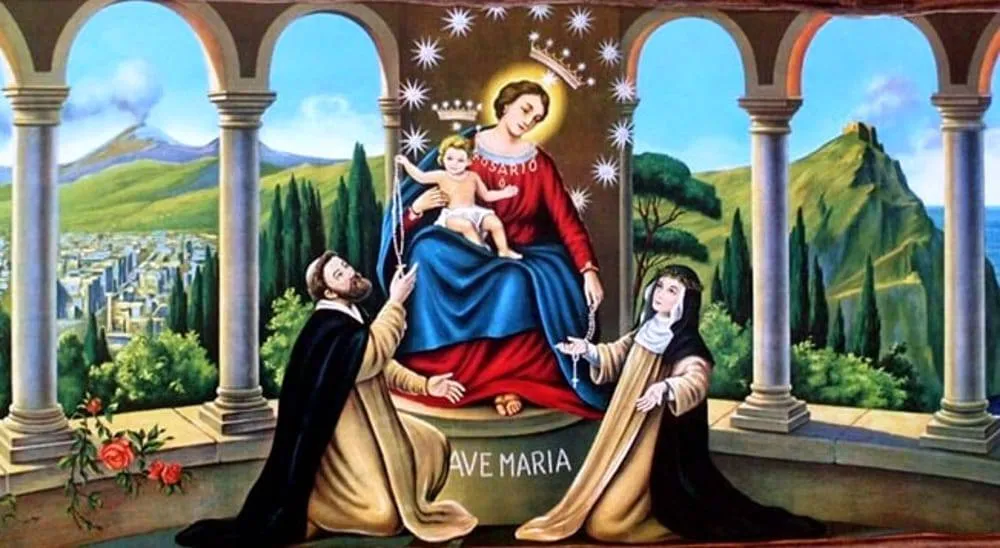
“Is there a shortcut to Paradise?” he was once asked. “Yes,” he replied, “it is Our Lady.” “She,” said the friar of Pietrelcina, “is the sea through which one reaches the shores of eternal splendors.” He always exhorted his spiritual children to pray the Rosary and to imitate Our Lady in her daily virtues such as humility, patience, silence, purity, and charity.
“I would like to have a voice so strong,” he said, “to invite sinners from all over the world to love Our Lady.”
He himself always had the rosary beads in his hand; he recited them incessantly, in full, especially during the night hours. “This prayer,” Padre Pio said, “is our faith, the support of our hope, the explosion of our charity.”
His spiritual testament, at the end of his life, was: “Love Our Lady and make her loved. Always recite the Rosary”.
Among the miraculous signs of the holy friar are, in addition to the stigmata, the gift of bilocation and the ability to read into the hearts and minds of people.
Death and Canonization
Padre Pio died at the age of 81 on September 23, 1968; more than a hundred thousand people from all over Italy attended his funeral.
On March 20, 1983, the diocesan process for his canonization began.
On January 21, 1990, Padre Pio was proclaimed venerable; he was beatified on May 2, 1999, and canonized on June 16, 2002, by Saint John Paul II (Karol Józef Wojtyła, 1978-2005).
Your servant, who prepared this hagiographic composition, met Padre Pio (on the occasion of a visit made to San Giovanni Rotondo with the Archbishopric Seminary of Naples) and was put out of the sacristy by Padre Pio himself, along with another seminarian who later became a priest (Don Luigi Graziuso), for taking two photos in secret (the film, strangely, turned out black).
In the church of the aforementioned friend, at the end of 1998, the effigy of Padre Pio became indelibly imprinted on a piece of Carrara marble on one of the pillars on the right side of the central nave, and it is still visible today.
For the record: the marble in question was removed and seized by the Curia, and returned after several months of careful checks to verify, as was the case, that there were no artifices. (gpm)
Prayer to Saint Pio of Pietrelcina by the Holy Father John Paul II
Teach us also, we pray, the humility of heart to be numbered among the little ones of the Gospel to whom the Father has promised to reveal the mysteries of His Kingdom.
Obtain for us a look of faith capable of promptly recognizing in the poor and the suffering the very face of Jesus.
Sustain us in the hour of combat and trial and, if we fall, grant that we may experience the joy of the sacrament of forgiveness.
Transmit to us the tender devotion toward Mary, Mother of Jesus and ours.
Accompany us on our earthly pilgrimage toward the blessed Homeland, where we hope to arrive as well to contemplate for eternity the Glory of the Father, the Son, and the Holy Spirit. Amen.
Joannes Paulus II
For further reading: Pio of Pietrelcina
Official Portal of Padre Pio of Pietrelcina | San Pio

(source © vangelodelgiorno.org)
Pietrelcina, May 25, 1887. It is among these space-time coordinates that the story of one of the most beloved Saints begins: Padre Pio, born Francesco Forgione. His life, inspired by the example of Saint Francis, has a constant reference: the Cross, the passion of Christ.
“A poor friar who prays”
He was born into a farming family and from childhood was animated by the desire to “become a friar.” At 16, he entered the novitiate of the Order of Friars Minor Capuchin in Morcone and chose to be called Friar Pio. In 1910, he received priestly ordination. Six years later, he entered the convent of Santa Maria delle Grazie in San Giovanni Rotondo. He dedicated many hours of the day to the sacrament of Confession. The peak of his apostolic commitment was the celebration of Holy Mass. He defined himself as “a poor friar who prays.” “Prayer,” he affirmed, “is the best weapon we have, a key to open the heart of God.”
An extraordinary encounter
In 1948, he confessed a young Polish priest, Don Karol Wojtyła, who 30 years later would ascend to the throne of Peter under the name of John Paul II. In the humble friar – the Pontiff underlined in 1999 during the beatification rite of Padre Pio – one catches a glimpse of the image of the suffering and Risen Christ:
“His body, marked by the ‘stigmata’, showed the intimate connection between death and resurrection”. “No less painful, and humanly perhaps even more burning – the Pope recalled in his homily – were the trials he had to endure as a consequence, one might say, of his singular charisms”. For Padre Pio, “suffering with Jesus” is a gift: “in contemplating the cross on Jesus’ shoulders I feel increasingly fortified and exult with a holy joy”. “All that Jesus suffered in his passion,” he reveals, “unworthily, I suffer too, as far as is possible for a human creature.”
“Relief of Suffering”
Padre Pio’s life is also the reflection of an incessant commitment aimed at alleviating the pains and miseries of so many families. In 1956, “Casa Sollievo della Sofferenza”, a cutting-edge hospital center, was inaugurated. It is the “apple of my eyes,” states the friar, who on the occasion of the inaugural speech adds: “This is the creature that Providence, helped by you, has created; I present it to you. Admire it and bless the Lord God together with me. A seed has been deposited in the earth which He will warm with His rays of love.”
Death
Padre Pio died in the night of September 23, 1968, at the age of 81. On June 16, 2002, he was proclaimed a saint by Pope John Paul II: “Padre Pio’s life and mission,” the Pontiff stated in his homily, “testify that difficulties and sorrows, if accepted for love, are transformed into a privileged path of holiness, which opens toward prospects of a greater good, known only to the Lord.”
fonte © Vatican News – Dicasterium pro Communicatione