
Saint Lucy: Virgin and Martyr (283-304)
Patroness of Syracuse
Lucy was born around the year 283 A.D. in Syracuse, to a noble Christian family. Lucy’s father, possibly named Lucius, died when she was still very young, so she was raised by her mother Eutychia, from whom she learned the truths of Christianity and the message of Jesus’ love. Thus, Lucy became acquainted with the stories of the early Christians, their martyrdom for the love of Jesus, and as she grew, she decided in her heart to consecrate herself with a perpetual vow of virginity.
Concerned about the worsening illness that had struck her mother—a hemorrhage considered incurable—Lucy suggested a pilgrimage to the tomb of the martyr Saint Agatha in Catania, as the fame of the glorious saint had spread everywhere due to the miracles she performed; in her heart, Lucy was certain that it would also benefit her dear mother.
Eutychia, full of hope, accepted Lucy’s suggestion, and they decided to set out on the pilgrimage to Catania, arriving precisely on the feast day of Saint Agatha: February 5, 301. During the celebration, they heard the passage from the Gospel of Matthew about the woman who suffered from hemorrhage and was healed by touching the hem of Jesus’ cloak. Enlightened, Lucy suggested to her mother to touch Saint Agatha’s tomb, convinced of the powerful intercession of the saint.
While Eutychia touched the tomb, Saint Agatha appeared to Lucy in a vision and said: “Lucy, my sister, why do you ask me for what you yourself can obtain for your mother? Behold, your mother is already healed by your faith.” Lucy told her mother: “Through the intercession of Saint Agatha, Jesus has healed you,” and, thinking it was the right moment, revealed to her mother her intention to consecrate herself to Jesus and to give her rich dowry to the poor: Eutychia consented, though reluctantly.
A young pagan from her city, in love with Lucy and disappointed by the refusal of marriage—since Lucy had explained that she had consecrated herself to Jesus—sought revenge, denouncing her as a follower of Christ to the terrible Roman prefect Pascasius. Emperor Diocletian had issued an edict providing for a fierce persecution of Christians.
Lucy Steadfast as a Rock
Lucy was arrested and brought before Prefect Pascasius, who ordered her to make sacrifices to the pagan gods to renounce her Christian faith, but Lucy firmly refused.
Pascasius realized he would gain nothing and ordered that the girl be taken to the worst slums of the city to be violated. Soldiers tried to seize her, but although her hands and feet were bound and she was pulled by six men and six oxen, they could not move her; inexplicably, Lucy remained steadfast as a rock.
Pascasius thought such a prodigy was the work of magic and, enraged, ordered her to be treated as a witch: she was doused with resin and pitch and set on fire, but the flames did not burn her. Lucy said to Pascasius: “I prayed to my Lord Jesus Christ that this fire would not harm me, so as to give the faithful courage for martyrdom…”
Furious, Pascasius condemned her to be beheaded. Before her execution, Lucy predicted the death of Diocletian, which occurred a few years later, and the end of the persecutions, concluded in 313 A.D. with Constantine’s edict.

Lucy Killed and Buried
Lucy was killed on December 13, 304, and was buried in the same place where, in 313, a sanctuary dedicated to her was built.
In 1039, the Byzantine general George Maniaces transferred Saint Lucy’s body from Syracuse to Constantinople to protect it from the threat of Saracen invasion of the city of Syracuse.
In 1204, during the Fourth Crusade, the Doge of Venice, Enrico Dandolo, found the saint’s remains in Constantinople, brought them to Venice to the Monastery of San Giorgio, and in 1280 transferred them to the church dedicated to her in Venice.
The sacred relics of the Sicilian saint returned exceptionally to Syracuse for seven days in December 2004 on the occasion of the 17th centenary of her martyrdom; the arrival and departure of the relics were greeted by an incredible crowd of Syracusans hoping for a permanent return.
Saint Lucy has saved Syracuse many times in its most dramatic moments, such as famines, earthquakes, and wars; she also intervened in other cities like Brescia, which, thanks to her intercession, was freed from a severe famine.
Saint Gregory the Great (590-604) included Saint Lucy in the canon of the Roman Mass. Some references can also be found in the “Summa Theologica” by Saint Thomas Aquinas.
Dante made her a symbol of illuminating Grace and declared himself her devotee. He considered her the protector of sight and, as he recounts in the “Convivio,” often turned to her for healing from eye ailments.
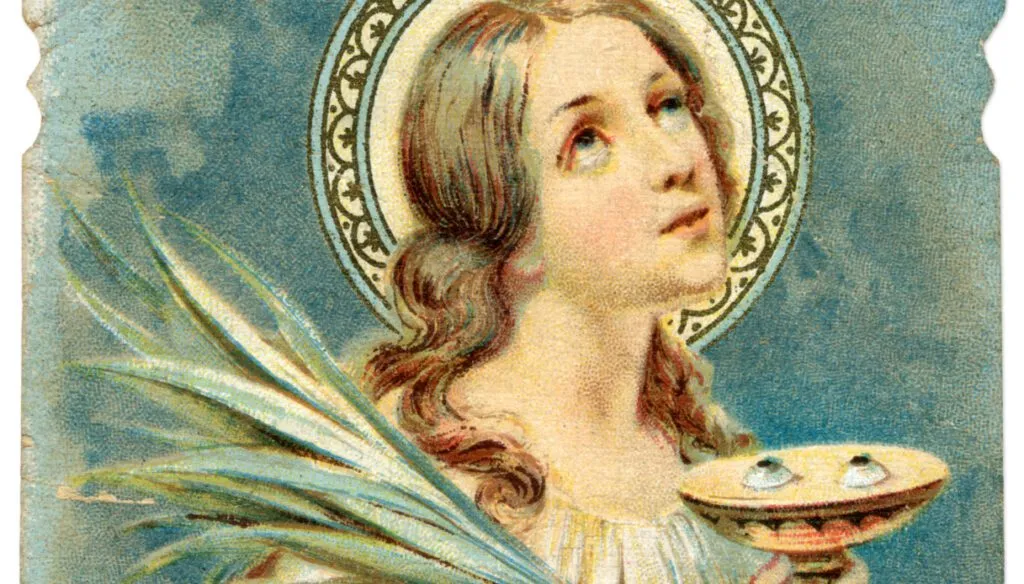
Popular legend says that the saint had her eyes torn out, which is why some iconography depicts her holding a tray with eyes on it.
The life of Saint Lucy, as often happens with early Christian saints, is woven with legendary elements; these testify to the immense veneration the saint has enjoyed and still enjoys both in Italy and worldwide.
Saint Lucy is the Patroness of Syracuse and many other cities in Italy and around the world: she is considered the protector of eyes, ophthalmologists, electricians, and stonemasons, and is often invoked in eye diseases.

Prayer
O glorious Saint Lucy, who associated the glory of martyrdom with the profession of faith, obtain for us the grace to openly profess the truths of the Gospel and to walk faithfully according to the teachings of the Savior.
O Virgin of Syracuse, be a light in our lives and a model for all our actions, so that, after imitating you here on earth, we may, together with you, enjoy the vision of the Lord. Amen.
Composed by Angelo Giuseppe Roncalli when he was Patriarch of Venice; he later became Pope John XXIII (1958-1963); beatified on September 3, 2000.

fonte © vangelodelgiorno.org
Lucy suffered martyrdom on December 13, 304. Denounced as a Christian, the prefect allegedly desired her eyes, and she, to thwart his passion, is said to have plucked them out and sent them to him on a silver plate. Hence the invocation of Lucy as the Protector of Eyes.
Her story is told through acts of martyrdom, traditions, folk tales, and legends. Lucy was born at the end of the 3rd century in Syracuse to a wealthy, high-ranking family.
Raised in the Christian faith, she was still a child when she became fatherless. Her mother Eutychia lovingly cared for her upbringing.
As a young girl, Lucy contemplated consecrating herself to God but kept her desire in her heart. Ignorant of her daughter’s intentions, Eutychia, as was customary then, promised her in marriage to a young man of good family but not Christian. Lucy did not reveal her wish to offer her virginity to Christ and postponed the marriage using various pretexts, relying on prayer and divine assistance.
The Journey to Catania and the Intercession of Saint Agatha
It was the year 301 when Lucy and her mother went on a pilgrimage to Catania, to the tomb of Saint Agatha. Eutychia suffered from hemorrhages, and despite various costly treatments, nothing had helped. Mother and daughter sought the grace of healing from the young Catanian martyr.
It was February 5 when they arrived at the slopes of Mount Etna, the dies natalis of Agatha.
They attended the Eucharistic celebration at the saint’s tomb and “it happened… that… upon hearing the Gospel episode of the woman with hemorrhage, who obtained healing by simply touching the hem of the Lord’s garment, Lucy, turning to her mother, said: ‘Mother, if you have faith in the things that have been read, you will also believe that Agatha, who suffered for Christ, has free and confident access to His tribunal.
Therefore, touch her tomb with trust, if you wish, and you will be healed’” (Passio of Saint Lucy). Eutychia and Lucy approached Agatha’s burial site. Lucy prayed for her mother and implored to dedicate her life to God. Absorbed and taken by a gentle sleep, as if raptured in ecstasy, she saw Agatha among the angels announcing: “Lucy, my sister and Virgin of the Lord, why do you ask me for what you yourself can grant?
Your faith has greatly helped your mother; she is already healed. And just as the city of Catania is filled with grace because of me, so will the city of Syracuse be preserved for you, because our Lord Jesus Christ has willed that you keep your virginity intact.”
Awakening, Lucy recounted to her mother what had happened, revealed her intention to renounce an earthly husband, and asked to sell her dowry to give charity to the poor.
The Martyrdom
Disappointed and irritated, the young man who desired her hand denounced her to Prefect Pascasius, accusing her of worshiping Christ and disobeying the edict of Diocletian.
Arrested and brought before the prefect, Lucy, interrogated, refused to sacrifice to the gods and proudly professed her faith: “I am a servant of the Eternal God, and He has said: ‘When you are brought before kings and rulers, do not worry about how or what you shall speak, for it will not be you speaking, but the Holy Spirit speaking in you’.”
Pascasius asked: “Oh, so you believe you have the Holy Spirit?” And Lucy: “The Apostle said: ‘The chaste are the temple of God, and the Holy Spirit dwells in them.’” Pascasius, seeking to discredit her, ordered her to be taken to the brothel; Lucy declared she would not yield to carnal lust and that any violence inflicted upon her body against her will would leave her chaste, pure, and uncontaminated in spirit and mind.
Miraculously immovable, the soldiers could not push her; bound hand and foot, not even with oxen could they drag her. Exasperated by the extraordinary event, Pascasius ordered the young woman to be burned.
But the fire did not harm her. Furious, Pascasius decided she should die by the sword. She was beheaded on December 13, 304.
fonte © Vatican News – Dicasterium pro Communicatione


