

Read the story of Saint Francis de Sales
Francis, born François, the eldest of thirteen children, was born in Savoy at the Castle of Sales, near Thorens, on August 21, 1567, to Francis I de Nouvelles, Lord of Boisy, and Frances de Sionnaz.
From an early age, he received a careful education, crowned by university studies in law in Paris and Padua. There, he received his doctoral cap with great praise and, upon returning to his homeland, was appointed advocate to the Senate of Chambéry. However, since his academic years, his preeminent theological interests had begun to emerge, eventually culminating in the discovery of his priestly vocation, which disappointed his father’s expectations.
Priest
Ordained a priest on December 18, 1593, he was sent to the Chablais region (a mountainous area in northern Savoy) dominated by Calvinism. There, he dedicated himself primarily to preaching, favoring the method of dialogue. He was a zealous priest and a tireless worker. Seeing the scarce results obtained from the pulpit, he began publishing pamphlets (broadsides) that he himself would slide under the doors of houses or post on walls; yet even those leaflets had little initial effect.
Driven by an enormous desire to safeguard Christianity while the Reformation led by Calvin and his followers raged, Francis requested an audience with the Bishop of Geneva so that he might be sent to that city—the supreme symbol of Calvinism and the main seat of the reformers. Once established in Geneva, he did not hesitate to discuss theology with Protestants, eager to recover as many “souls” as possible for the Church and especially for the cause of Christ, which he believed to be genuine.
Furthermore, his constant thought was turned to the condition of the laity, concerning himself with developing a style of preaching and a model of Christian life that was accessible even to common people—those immersed in the difficult life of every day.
His teachings, pervaded by understanding and gentleness, became proverbial, permeated by the firm conviction that God’s presence always supported human actions. Many of his teachings are steeped in mysticism and noble spiritual elevation (the Garzanti Encyclopedia of Literature defines him as: “an elegant preacher and prose writer far from harsh tones, skilled in weaving together images and ideas”).
His enormous efforts and the great successes achieved in pastoral terms earned him the appointment as coadjutor bishop of Geneva as early as 1599, at thirty-two years of age and after only six years of priesthood.
Bishop
After another three years, he became bishop in his own right and dedicated himself to introducing the reforms promulgated by the Council of Trent into his diocese. The city overall remained in the hands of the reformers, and the new bishop had to transfer his see to the Savoyard town of Annecy, the “Venice of the Alps,” on the shores of the lake of the same name.
He was also the spiritual director of St. Vincent de Paul. During his mission as a preacher, in 1604, he met the noblewoman Jane Frances Frémyot, widow of the Baron de Chantal, in Dijon. With her, he began a correspondence and a deep friendship that led to the foundation of the “Order of the Visitation.”
“If I am to err, I would rather err through too much kindness than through too much rigor”: in this statement by Francis de Sales lies the secret of the affection he inspired among his contemporaries.
The Duke of Savoy, on whom Francis depended politically, supported the work of the unheeded apostle with force, but intolerance did not suit the saint’s temperament. The latter preferred to carry out his battle for orthodoxy through the method of charity, enlightening consciences with his writings, for which he received the title of Doctor of the Church.
The Works
His main works were:
– “Philothea” (St. Francis de Sales expressed himself this way in the preface to his book: “I address my words to Philothea; wanting to make available to many souls what I had originally written for only one, I use the name common to all those who want to be devout; Philothea, in fact, means a lover and one who desires to love God”);
– “Treatise on the Love of God,” fundamental texts of religious literature of all time. The love of God was the argument with which he convinced the reluctant Huguenots to return to the heart of the Catholic Church.
Death
On December 11, 1622, in Lyon, he had his last meeting with his penitent, and he died there from an apoplectic fit on the 28th of the same month in the small room of the chaplain of the Sisters of the Visitation at the monastery.
On January 24, 1623, the saint’s mortal body was translated to Annecy, to the church now dedicated to him, but later it was placed for the veneration of the faithful in the Basilica of the Visitation, on the hill adjacent to the city, alongside St. Jane Frances de Chantal.
Francis de Sales was beatified in 1661 and canonized in 1665 by Pope Alexander VII (Fabio Chigi, 1655-1667).
Pope Leo XIII (Vincenzo Gioacchino Raffaele Luigi Pecci, 1878-1903) proclaimed him a Doctor of the Church in 1887; Pope Pius XI (Ambrogio Damiano Achille Ratti, 1922-1939) proclaimed him “Patron of Journalists” in 1923.
St. Francis de Sales, considered the father of modern spirituality, influenced the major figures not only of the French “grand siècle” but also of the entire European seventeenth century, even managing to convert some members of Calvinism to Catholicism.
Finally, it is worth remembering how several congregations were inspired by his name, the most famous of which is undoubtedly the Salesian Family founded by St. John Bosco, whose attention is directed primarily to the growth and education of young generations, with special care for the children of the less affluent classes.
Meaning of the name Francis: “free man” (Ancient German).
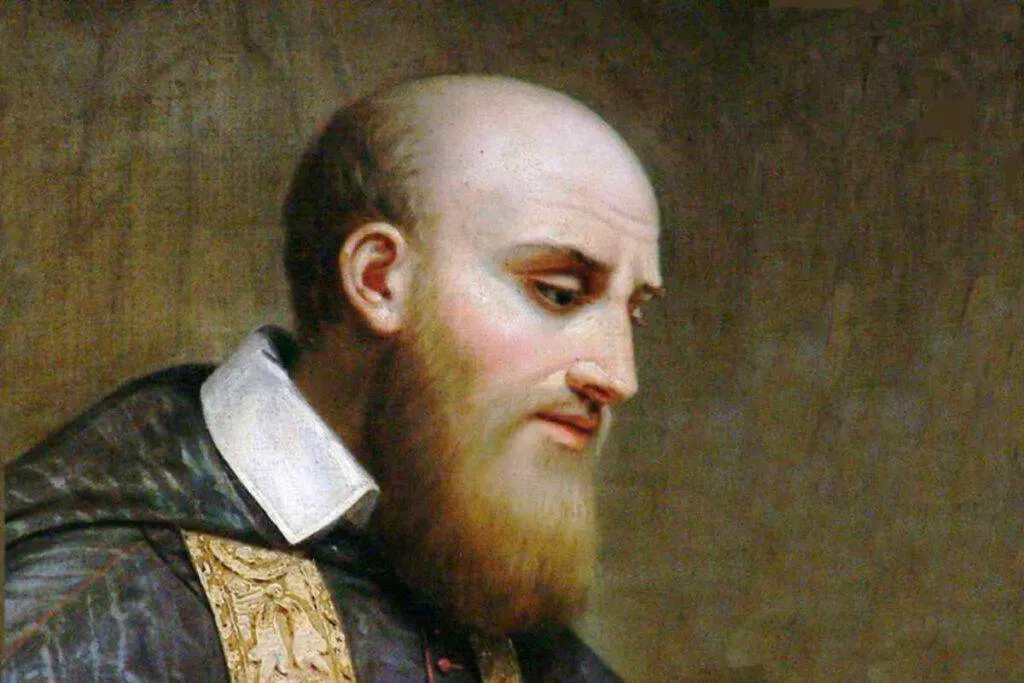
French (1567-1622), he was a man of dialogue and gentleness without ever renouncing the truth. He was one of the first modern evangelizers, using leaflets and posters. He proposed a model of Christian life for all states, to be realized within the difficulties of daily life.
He was born on August 21, 1567, in Thorens-Glières, France, to the noble and ancient Boisy family of Savoy. He was educated in the best French colleges, then followed the will of his father, who dreamed of a legal career for him, and went to study law at the University of Padua. It was here that he matured an interest in theology.
He graduated with top honors and, returning to France in 1592, registered as a lawyer. But his greatest desire was now to become a priest; thus, the following year, on December 18, he was ordained a priest, and three days later, at the age of 26, he celebrated his first Mass. Appointed archpriest of the cathedral chapter of Geneva, Francis showed gifts of zeal, charity, diplomacy, and balance.
Amidst the spread of Calvinism, he volunteered to re-evangelize the Chablais region. In his preaching, he sought dialogue but faced closed doors, snow, cold, hunger, nights in the open, ambushes, insults, and threats.
He then studied Calvin’s doctrine to understand it deeply and better explain the differences with the Catholic faith. Instead of relying solely on preaching and theological dispute, he devised a system of publishing and posting leaflets and posters in public places or leaving them door-to-door, explaining individual truths of faith in a simple and effective way.
The conversions were not many at first, but hostility and prejudice toward Catholicism ceased. Francis then settled in Thonon, the capital of Chablais, where he dedicated himself, among other things, to visiting the sick, works of charity, and personal talks with the faithful. He then asked to be transferred to Geneva, the symbolic city of Calvinist doctrine, with the desire to recover as many believers as possible to the Catholic Church.
The Episcopate in Geneva and friendship with Jane Frances Frémyot de Chantal
In 1599, he was appointed coadjutor bishop of Geneva; three years later, the diocese was entirely in his hands, with its see in Annecy. Francis spent himself without reserve: visiting parishes, training clergy, reorganizing monasteries and convents, and sparing no effort in preaching, catechesis, and initiatives for the faithful.
He chose dialogued catechism, and his perseverance and gentleness in spiritual direction guided various conversions. In March 1604, during Lenten preaching in Dijon, he met Jane Frances Frémyot de Chantal, with whom he established a beautiful friendship that also gave rise to a collection of spiritual direction letters.
In 1608, he dedicated Philothea or Introduction to the Devout Life to her. Philothea is the ideal name for one who loves or wants to love God; Francis conceived the text to summarize the principles of inner life in a concise and practical way and to teach how to love God with all one’s heart and strength in everyday life. The idea was to train those living in the world who must fulfill civil and social duties for a fully Christian life. The writing was an enormous success.
The birth of the Congregation of the Visitation of Holy Mary
The long and intense collaboration between Francis and Jane brought forth great spiritual fruits. Among these was the Congregation of the Visitation of Holy Mary, founded in 1610 in Annecy with the primary purpose of visiting and helping the poor.
Eight years later, the congregation became a contemplative order (today the nuns are called Visitandines); Francis himself dictated the constitutions, inspired by the Rule of St. Augustine. However, de Chantal later arranged for her religious sisters to also handle the education and instruction of young girls, especially from wealthy families.
In 1616, Francis wrote Theotimus or Treatise on the Love of God, a work of extraordinary theological, philosophical, and spiritual depth, conceived as a long letter addressed to his friend “Theotimus,” presenting to every man his essential vocation: to live is to love. The text aims to indicate the best ways for each person to realize a personal encounter with God.
Francis de Sales died on December 28, 1622, in Lyon at the age of 52, and on January 24 of the following year, his remains were translated to Annecy.
Links:
https://w2.vatican.va/content/benedict-xvi/en/audiences/2011/documents/hf_ben-xvi_aud_20110302.html