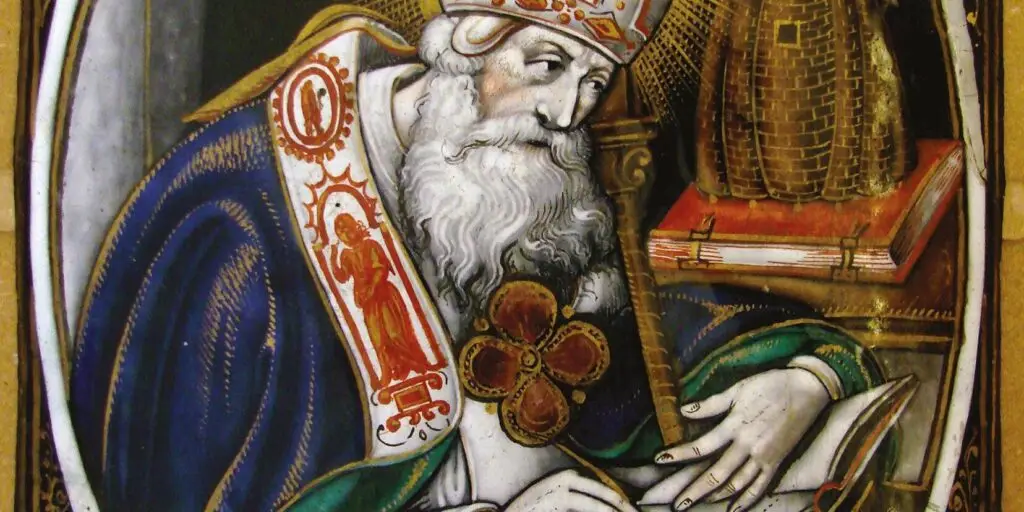

Saint Ambrose, Bishop of Milan and Doctor of the Church
He is among the great saintly doctors of the Western Church. Bishop of Milan, inventor of hymns, initiator of Mariology, Saint Ambrose embodies the ideal of the pastor. Remembered by the Church on December 7, he was the author of famous liturgical texts and inflexible against heresy.
These were times of wrenching social divisions. On December 7, 374, in a church in Milan the discussion had become heated. The thorny designation of the city’s new bishop, the capital of the Western Roman Empire, had exacerbated the distance between Catholics and Arians.
The denial of Christ’s divinity, supported by the latter and opposed by the former, was perceived as an insurmountable barrier in choosing a pastor who could represent both.
A Bishop for Everyone
Ambrose, the governor of Lombardy, Liguria, and Emilia, known for his impartiality and fairness, was called upon to mediate. His name was Ambrose, born in 340 in Trier, Germany, to a Christian Roman family, the third child after two siblings, Saints Marcellina and Satyrus.
In Rome, he had completed his legal studies, following in the footsteps of his father, the prefect of Gaul, learning oratory and Greco-Latin literature. His successes in his magisterial career and his balance in managing even the thorniest controversies made him the ideal candidate to moderate the heated Milanese debate that began after the death of the Arian bishop Auxentius.
Ambrose’s invitation to dialogue convinced the people and averted the outbreak of riots. Just when the governor thought he had successfully completed his mission, the unexpected happened: a child’s voice rose loudly from the crowd, echoed by the entire assembly: “Ambrose, bishop!” Catholics and Arians, with unexpected harmony, had found an agreement.
The people’s invocation caught Ambrose off guard: he was not baptized, and he felt inadequate. He objected, appealing to the Emperor Valentinian, who, however, confirmed the popular will. Ambrose then fled, but Pope Damasus also deemed him suitable for the episcopal dignity; he then understood God’s call and accepted, becoming the Bishop of Milan at only 34 years old.
In Prayer, Beside the People
He distributed all his goods to the poor and dedicated himself to the study of the Sacred Texts and the Church Fathers: “When I read the Scriptures,” he said, “God walks with me in Paradise.”
He learned to preach, and his oratory fascinated the young Augustine of Hippo, marking his conversion. Ambrose’s life became increasingly frugal and austere, entirely spent in study, prayer, diligent listening, and closeness to the poor and the people of God.
“If the Church has gold, it is not to keep it, but to give it to those in need,” he said when he decided to melt down liturgical furnishings to pay the ransom for some faithful who had been seized by northern soldiers.
The Fight Against Heresy
Peace and concord were his priorities, but he never tolerated error. Artistic iconography depicts him with a whip, striking the heretics.
His fight against Arianism was energetic, leading him to clash even with governors and sovereigns. Ambrose emerged victorious from that conflict, which erupted under the pro-Arian Empress Justina, asserting the independence of spiritual power from temporal power. The episode of the Massacre of Thessalonica in 390 is emblematic.
Following the slaughter of seven thousand people who revolted over the death of the governor, Ambrose succeeded in inducing the repentance of Theodosius, who had ordered it. “The emperor is in the Church, not above the Church” was the conviction of the Milanese bishop who, despite the law, did not hand over a single church to the Arians.
The Primacy of Peter
Ambrose also always recognized the primacy of the Bishop of Rome, asserting: “Ubi Petrus, ibi Ecclesia” (Where Peter is, there is the Church). Love for Christ, the Church, and Mary emerges from his copious literary and theological production, which earned him, along with Saints Jerome, Augustine, and Gregory the Great, the title of great Doctor of the Western Church.
A builder of basilicas, inventor of hymns that revolutionized prayer, and tireless in oration, Ambrose died on Holy Saturday in 397.
An immense crowd rushed to pay homage to him on Easter Sunday.
🍝 La Pasta che fa bene al cuore
Partecipa alla Seconda Edizione del nostro evento di solidarietà.
Unisciti a noi per trasformare un piatto di pasta in un gesto d’amore ❤️