
Memory: Blessed Virgin Mary of the Rosary
The Rosary was born from Christians’ love for Mary in the Middle Ages, perhaps during the Crusades in the Holy Land. The object used to recite this prayer, the rosary, is of very ancient origin.
The Eastern anchorites (an anchorite is a religious man who abandons the active life and distances himself from others, living an isolated life of asceticism and contemplation) used small stones to count the number of vocal prayers.
In medieval convents, lay brothers, excused from reciting the Psalter due to their lack of familiarity with Latin, supplemented their devotional practices with the recitation of the “Our Fathers,” for which counting, St. Bede the Venerable had suggested using a string of beads strung on a string.
Then, legend has it, the Madonna herself, appearing to St. Dominic, showed him the recitation of the Rosary as an effective weapon for defeating the Albigensian heresy. Thus was born the devotion to the rosary, which signifies a garland of roses offered to the Madonna.
Confraternity of the Rosary
The promoters of this devotion were, in fact, the Dominicans, who also founded the Confraternities of the Rosary.
It was a Dominican pope, St. Pius V (Antonio Michele Ghislieri, 1566-1572), who first encouraged and officially recommended the recitation of the Rosary. It quickly became the popular prayer par excellence, a kind of “people’s breviary,” to be recited in the evening as a family, as it lends itself perfectly to providing spiritual direction to the family liturgy.
The celebration of today’s feast was instituted by St. Pius V in 1572 (Salvatoris Domini papal bull) to commemorate the victory won on October 7, 1571, at Lepanto against the Turkish fleet (initially it was called “Our Lady of Victory”); that year it fell on a Sunday. Later, in 1716, it was extended to the universal Church, and definitively fixed on October 7th by St. Pius X (Giuseppe Sarto, 1903-1914) in 1913.
The “Feast of the Most Holy Rosary,” as it was called before the calendar reform, in a certain sense summarizes all the feasts of Our Lady and the mysteries of Jesus, with which Mary was associated, with the meditation of fifteen moments in the life of Mary and Jesus.
Saint John Paul II
Saint John Paul II (Karol Józef Wojtyła, 1978-2005), with the apostolic letter Rosarium Virginis Mariae of October 16, 2002, added the Mysteries of Light, inserted between the Joyful and Sorrowful Mysteries, to the Joyful, Sorrowful, and Glorious Mysteries, thus bringing the number of moments of contemplation of life to twenty. of Mary and Jesus.
Fonte principale: santiebeati.it («RIV.»).
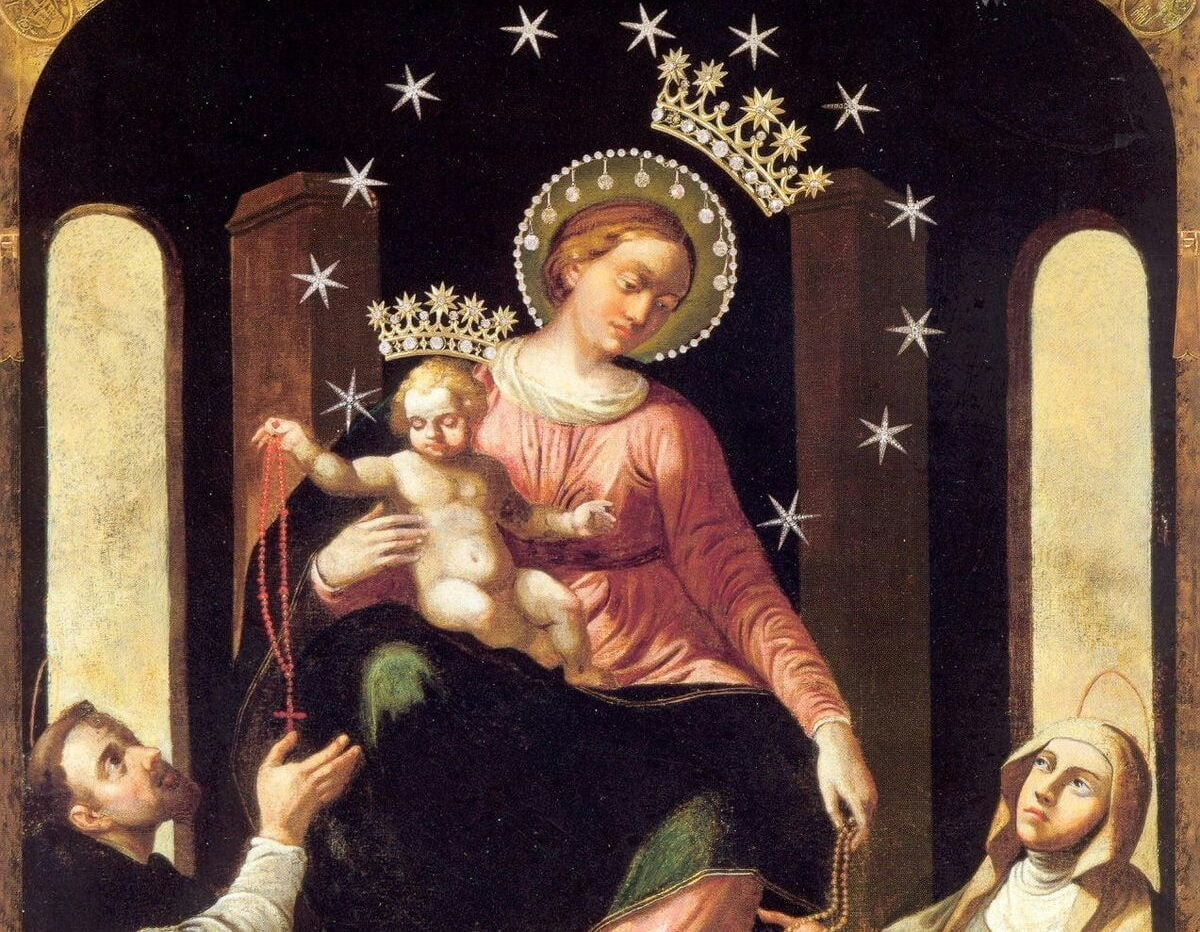
Our Lady of the Rosary of Pompeii is celebrated on October 7 and May 8 with the recitation of the Solemn Supplication. The cult dates back to the 13th century and was spread by the Dominican Order. In 1572, Pope Pius V established the Feast of the Holy Rosary after the Christian fleet’s victory over the Muslim Turks at Lepanto in 1571. The Pope recognized the victory through Mary’s intercession, and he invited the people to pray for her by reciting the Rosary. After the apparitions at Lourdes in 1858, where the Virgin Mary encouraged the practice of the Rosary, the cult spread with greater intensity.
The greatest witness and propagator of the devotion of the Rosary was Blessed Bartolo Longo, a former anticlerical lawyer (1841-1926). While studying in Naples, he embraced spiritualism. One night, in the throes of a serious crisis, on the advice of his friend Vincenzo Pepe, he turned to Father Radente, a Dominican, who accompanied him until he joined the Third Order of Saint Dominic. After graduating, Bartolo devoted himself to charitable work, taking a vow of chastity. During this time, he met Countess Marianna Farnararo De Fusco, who was widowed at the age of 27.
Needing an administrator for her assets and a tutor for her five children, she enlisted Bartolo, who moved into her residence. However, the situation gave rise to gossip, so much so that the two married only to silence the rumors, continuing to live as friends. The countess owned properties and homes as far away as Pompeii, and Bartolo, as administrator, visited there frequently. During these travels, he became aware of the people’s ignorance, so much so that he devoted himself to teaching, catechism, and the practice of reciting the Rosary.
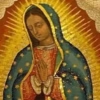
One day, Sister Maria Concetta de Litala gave Bartolo an old and neglected canvas depicting Our Lady of the Rosary. He restored it and took it to Pompeii, where it was displayed in a small chapel from February 13, 1876. Due to the crowds of pilgrims who flocked there for the abundant graces and miracles the Madonna bestowed, the chapel grew increasingly smaller, and so, by May 9, 1876, a new church was built, inaugurated in 1887. The image was subsequently crowned with a golden diadem by Pope Leo XII.
In the sixth month, the angel Gabriel was sent from God to a town in Galilee called Nazareth, to a virgin engaged to a man whose name was Joseph, of the house of David. The virgin's name was Mary. And he came to her and said, "Greetings, full of grace, the Lord is with you."
But she was greatly troubled by his words and pondered what sort of greeting this might be. The angel said to her, "Do not be afraid, Mary, for you have found favor with God. And behold, you will conceive in your womb and bear a son, and you shall name him Jesus. 32He will be great and will be called the Son of the Most High; and the Lord God will give to him the throne of his father David, 33and he will reign over the house of Jacob forever, and of his kingdom there will be no end." Then Mary said to the angel, "How can this be, since I am a virgin?" The angel answered her, "The Holy Spirit will come upon you, and the power of the Most High will overshadow you. Therefore the child to be born will be called holy, the Son of God. And behold, your relative Elizabeth has also conceived a son in her old age, and this is the sixth month with her who was called barren. For nothing will be impossible with God." Then Mary said, "Behold, I am the handmaid of the Lord; let it be done to me according to your word." And the angel departed from her (Lk 1:26-38).
Wonder
Today’s liturgy places us in the school of Mary, beloved disciple of the Lord Jesus. From her today, in the light of the Gospel, we learn “wonder,” the willingness to be amazed by God. She becomes a Mother, even though she is a virgin, and Elizabeth, now in her sixth month, even though she is elderly (Luke 1:36).
Wonder allows Mary to let God do the work, and this willingness will allow the Expected One of the nations to blossom within her.
This first attitude of Mary teaches us today, on the feast of Our Lady of the Rosary, to know how to entrust ourselves to the intercession of the Virgin Mother, through the recitation of the Holy Rosary. What may seem humanly impossible to our human strength alone, even through Mary’s grace, every battle in life, whether interior or exterior, can be won.
Turn your gaze upward
Alongside wonder, Mary teaches us today to turn our gaze upward. To trust and entrust ourselves to the Lord. A gesture through which we recognize that we cannot do it alone; that we are not the architects of our own destiny, and that we need each other and, together, we need God. The Lord never leaves us alone, as he promised, but we must believe first, beginning by detaching our gaze from earthly things and learning to fix it on heaven, from where help comes to us (see Psalm 121).
Entrusting ourselves to the prayer of the Holy Rosary is the sign through which we recognize that God is at work in us and around us, and through Mary’s intercession we can cultivate a “high standard of living.” Believing is precisely giving credence to the One who can do everything; welcoming his help, recognizing that we cannot do everything alone; trusting in Him even when his plans do not align with ours, to the point of offering ourselves with confidence: “Behold, I am the handmaid of the Lord. Let it be to me according to your word.”
God’s Time and Human Time
A third lesson we draw from this Gospel passage is to learn from Mary and with Mary to trust in God’s time. It is also a time of silence, waiting, and patience. We live in the time of “everything now.” There is “kronos,” human time, marked by the hours, by daily routines.
It is the time in which time is consumed voraciously, superficially, hastily. A sort of “throwaway.” Then there is “kairos,” the “right, opportune moment,” the moment of opportunity, capable of qualifying every instant. It is the time that savors with time, that demands that we delve deeply into things so that they may bear fruit in due time. It is living every encounter, every experience with quality, because it is the time of love, of listening, of attention to others.
It is a time when each of us does not simply live, but makes our own choices, seizing the opportunities we are given to grow, knowing how to create and recreate them, as long as they give meaning to existence. This is the time when living is where living is loving. Mary teaches us about this time. She teaches us to let ourselves be enchanted by this frenetic pace of life, to discover and savor the things of God.
Prayer
We take refuge under your protection,
Holy Mother of God: do not despise the supplications
of us who are put to the test, and deliver us from every danger,
O glorious and blessed Virgin.
fonte © Vatican News – Dicasterium pro Communicatione