
The Chaplet of Divine Mercy is a Catholic Christian prayer.
Its origins date back to a private revelation that Saint Faustina Kowalska claims to have received from Jesus in 1935, in which He allegedly requested a specific form of prayer called the Chaplet of Divine Mercy. According to Sister Faustina, special graces would be granted to those who recite this prayer
My mercy will embrace in life, and especially at the hour of death, the souls that recite this chaplet. It pleases Me to grant everything they ask of Me by reciting this chaplet. The priests will recommend it to sinners as the last board of salvation; even if it were the most hardened sinner, if he recites this chaplet only once, he will receive the grace of My infinite mercy. When this chaplet is recited near a dying person, the wrath of God is appeased, and the unfathomable mercy envelops the soul
The prayer entered the tradition of the Catholic Church and spread primarily following the institution of the Feast of Divine Mercy by John Paul II, and has since been recommended by his successors, such as Pope Francis, and is prayed, similar to the Rosary, including through the media.
At three in the afternoon, the short prayer is recited after making the Sign of the Cross: “O Blood and Water, which gushed forth from the Heart of Jesus as a fount of Mercy for us, I trust in You” followed by the Our Father, Hail Mary, and the Creed (“Apostles’ Creed”).
If it is possible to dedicate less than 10 minutes to Jesus Christ, the entire Chaplet of Divine Mercy is recited, and the “short prayer” is said both at the beginning and the end.
It is recited using the Rosary beads
- It begins by reciting, after the Sign of the Cross, an Our Father, a Hail Mary, and the Creed (in the version of the “Apostles’ Creed“).
- On the 5 (five) Our Father beads, which are the large beads of the Holy Rosary, one says: «Eternal Father, I offer You the Body and Blood, Soul and Divinity of Your dearly beloved Son, Our Lord Jesus Christ, in atonement for our sins and those of the whole world.»
- On the 50 (fifty) smaller beads one says: «For the sake of His sorrowful Passion, have mercy on us and on the whole world.»
- At the conclusion, one says three times: «Holy God, Holy Mighty One, Holy Immortal One, have mercy on us and on the whole world.»
- The prayer ends with the following invocation: «O Blood and Water, which gushed forth from the Heart of Jesus as a fount of Mercy for us, I trust in You!»; and finally, the Sign of the Cross again.
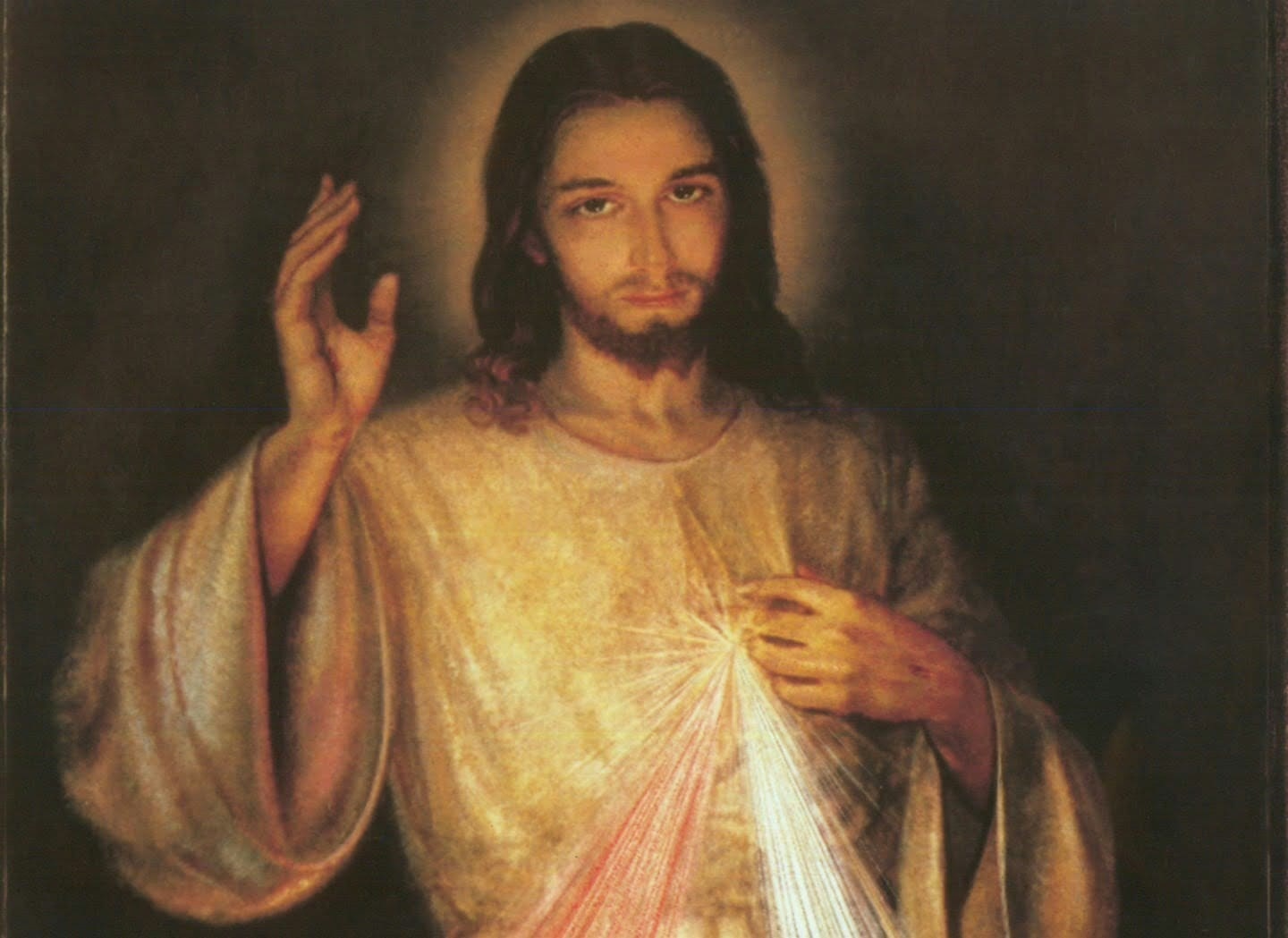
The image depicts Merciful Jesus, with His right hand raised, and two rays flowing from His Heart, one white and one red, representing water and blood respectively. Jesus is depicted in a white tunic, outlined by light, against a blue background, and bears the phrase «Jezu, ufam tobie» (“Jesus, I trust in You”) at the bottom. It is the artistic representation of the visions that Sister Faustina claimed to have received.
The image was first painted in Vilnius, Lithuania by the artist Eugeniusz Kazimirowski, after his neighbor and spiritual director of Sister Faustina, Father Michał Sopoćko, had partially informed him of the mission that Sister Faustina claimed to have received. The painter spent about six months completing the ordered work, under the continuous presence and control of the nun and the priest. Sister Faustina was particularly demanding and constantly requested corrections or additions of details, to obtain an image faithful to the vision. The face in the painting correctly matches the face of the Holy Shroud of Turin.
(source Wikipedia)