Blessed Virgin Mary of Guadalupe
Our Lady of Guadalupe
Our Lady of Guadalupe is mainly venerated in the Sanctuary dedicated to Her at Tepeyac, in Mexico. Every year, millions of pilgrims flock to this Sanctuary, making it the most visited and beloved not only by the Mexican people but also by all Latin American peoples.
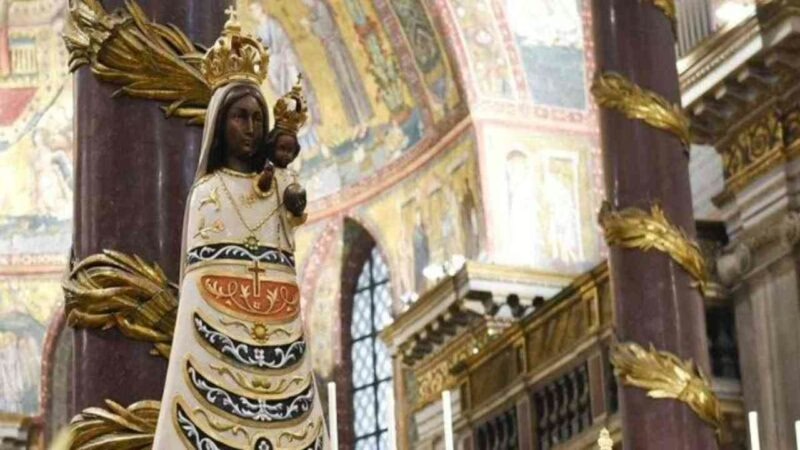
Today, there is no part of the Christian world that does not know the event that gave the decisive impulse to the evangelization of the “New World”. Sanctuaries dedicated to Our Lady of Guadalupe can also be found in Italy, as well as numerous chapels in places of worship, even famous ones, such as the Marian Sanctuary of Loreto.
The four apparitions of the “Virgen Morena” to the indigenous Juan Diego are at the origin of devotion and of the construction of the aforementioned Sanctuary; they are also an event that has left a deep mark on Mexican religiosity and culture.
The basilica, where the “tilma” (a cloak made of ayate fiber, a coarse fabric produced from cactus leaves) with the miraculous image is currently preserved, was inaugurated on October 12, 1976. Three years later it was visited by Saint John Paul II who, from the balcony of the façade where the words of the Virgin to Juan Diego are written in golden letters: “¿No estoy yo aquí que soy tu Madre?” (“Am I not here, I who am your Mother?”), greeted the many thousands of Mexicans gathered at Tepeyac; at the same location, on May 6, 1990, he beatified the visionary Juan Diego, who was finally canonized on July 31, 2002.
Here, on Tepeyac, the apparitions to Juan Diego took place: on the morning of December 9, 1531, while crossing the hill of Tepeyac to reach the city, the indigenous man was attracted by the harmonious singing of birds and the sweet vision of a Woman who called him by name with tenderness. The “Lady” told him that she was “the perfect ever-Virgin Mary, Mother of the true and only God” and ordered him to go to the bishop to tell him that she wished a temple to be erected at the foot of the hill. Juan Diego immediately ran to the bishop but was not believed.
On his way home that evening, he encountered the Virgin Mary again on Tepeyac, to whom he reported his failure and asked to be excused from the task entrusted to him, declaring himself unworthy. The Virgin ordered him to return the next day to the bishop who, after asking many questions about the place and circumstances of the apparition, requested a sign; the Virgin promised to give it to him the following day.
However, the next day, Juan Diego could not return: his uncle, Juan Bernardino, was gravely ill, and he was sent early in the morning to Tlatelolco to find a priest to confess the dying man. Upon approaching Tepeyac, he decided to change his path to avoid meeting the “Lady”. But the “Lady” was there and asked him why he was in such a hurry. Juan Diego fell at her feet and asked forgiveness for not being able to carry out the mission entrusted to him because of his uncle’s mortal illness.
The “Lady” reassured him, stating that his uncle was already healed, and invited him to climb to the top of the hill to pick flowers. Juan Diego climbed and, to his great amazement, found beautiful “Castilian roses” at the top of the hill: it was December 12. At this time of year, the winter solstice according to the Julian calendar in use then, neither the season nor the location, a desolate stony hill, was suitable for the growth of such flowers. Juan Diego gathered a bouquet and brought it to the Virgin, who then ordered him to present it to the bishop as proof of the truth of the apparitions.
Juan Diego obeyed, and upon reaching the bishop, he opened his cloak, and instantly on the “tilma” the image of the Holy Virgin was imprinted and made visible to everyone. Confronted with this prodigy, the bishop fell to his knees, along with all present.
The next morning, Juan Diego accompanied the prelate to Tepeyac to indicate the place where the Virgin asked a temple to be erected. Meanwhile, the image, placed in the cathedral, quickly became the object of popular devotion that has been preserved uninterruptedly to this day.
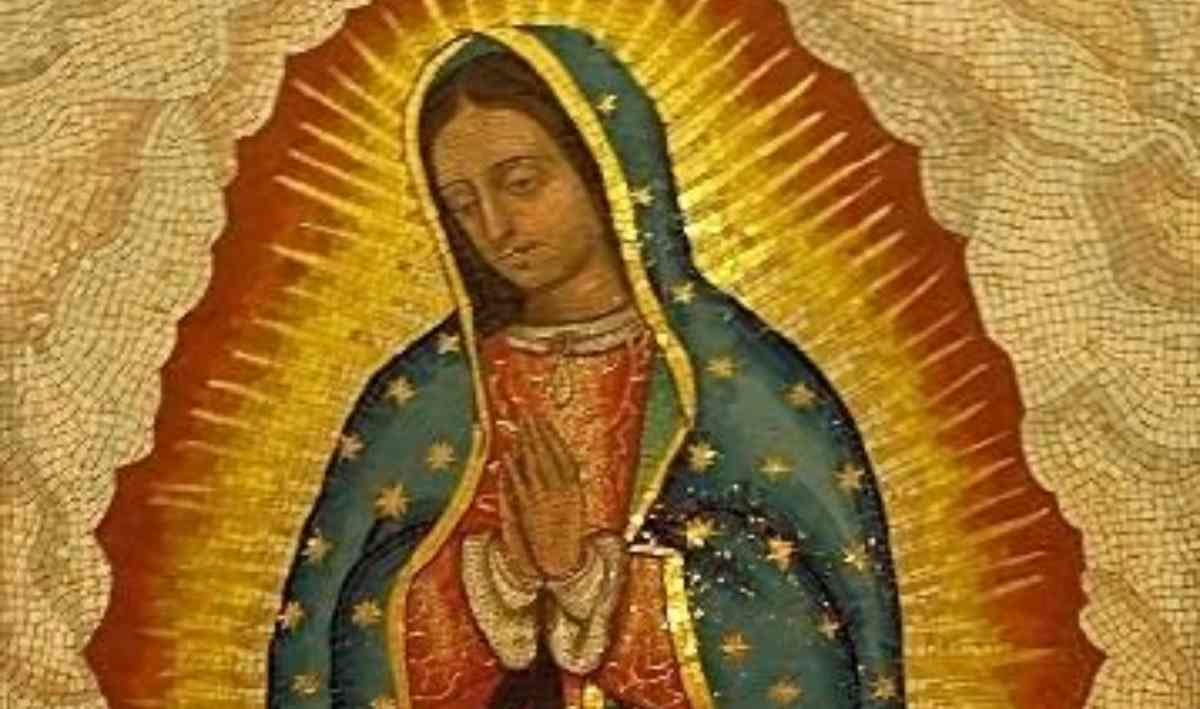
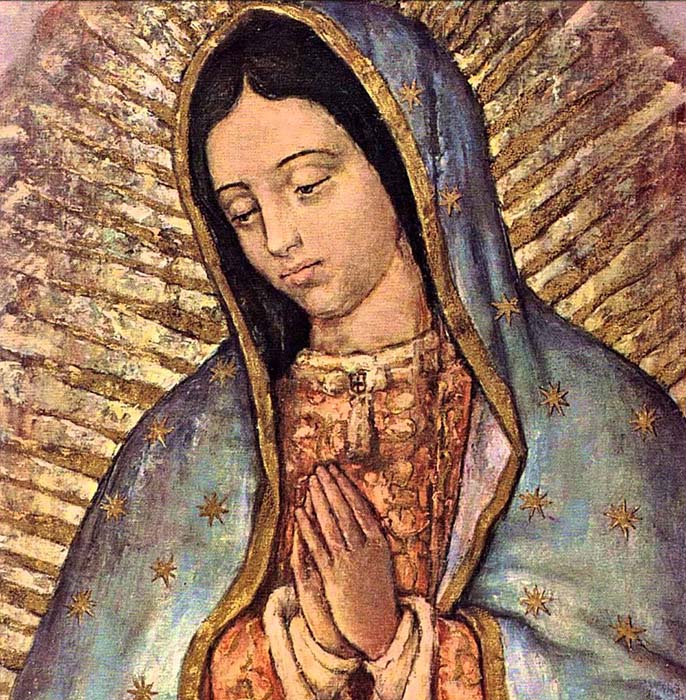
The Virgin on the “tilma” has a noble face, brown in color, hands joined, and wears a pink robe edged with flowers. A sky-blue mantle, adorned with golden stars, covers her head and falls to her feet, which rest upon the moon. Behind her, the sun shines with its hundred rays.
All attention is focused on the extraordinary and beautiful Guadalupan icon, which has remained inexplicably intact despite the passing centuries: this image, which is neither a painting nor a drawing nor made by human hands, inspires devotion among the faithful worldwide and poses many questions for science, much like the mystery of the Holy Shroud has done for years.
The most astonishing discovery in this regard was made, with the aid of sophisticated electronic equipment, by a commission of scientists who identified a group of 13 people reflected in the pupils of the “Virgen Morena”: allegedly Juan Diego himself with the bishop and other unknown figures, present that day at the miraculous event in the prelate’s house. A true puzzle for scholars: a scientifically inexplicable phenomenon that reveals the miraculous origin of the image and conveys a great message of Hope to the entire world.
Our Lady of Guadalupe, who appears to Juan Diego clothed in the sun, not only announces to him that she is our spiritual mother but invites him – as she invites each of us – to open our hearts to the work of Christ who loves and saves us. Reflecting today on the Guadalupan event, a case of miraculous “inculturation,” means learning from Mary, teacher of humanity and faith, herald and servant of the Word, which must shine in all its splendor, like the mysterious image on the tilma of the Mexican visionary, canonized by Saint John Paul II on July 31, 2002, during his fifth pastoral visit to Mexico.
Main sources: santiebeati.it; vatican.va (« RIV.»).
The Encounter with Juan Diego
In 1531, the Blessed Virgin Mary of Guadalupe appeared to Juan Diego, an Aztec who had converted to Christianity. At that time, Mexico was shaken by violence and, above all, by continuous violations of human dignity. The indigenous population was particularly subjected to severe discrimination.
The Marian apparitions seal the encounter between the natives and Christ. Mary presents herself as the “Mother of the true God.” The Blessed Virgin chose Juan Diego as her messenger. The man reported that the Virgin told him to build a sanctuary at that place. The bishop did not believe his words. On December 12, 1531, the Virgin caused fragrant roses to grow on the ground in the middle of winter. Juan Diego collected them in his cloak. When he opened it to show the flowers, the image of Mary appeared before the bishop, portrayed as a young indigenous woman. For this reason, the faithful call her “Virgen morenita.”
The Tilma
The cloak is made of two pieces of ayate. The tilma is a fabric of agave fibers, used in Mexico by the indigenous people to make clothing. The Virgin, with dark skin, wears a pink tunic. She is surrounded by rays of sunlight, and under the moon at her feet appears an angel.
The Gaze of Mary
In the image on the cloak, Mary’s eyes show venous branching like the human eye. In the eyelids, details of extraordinary precision appear. These images are so tiny that only with magnification techniques up to two thousand times could they be identified. In the right eye appears an indigenous family group: a woman with a child on her shoulder and a man wearing a hat similar to a sombrero watching them. In the left eye appears an elderly man with a beard, identified as the bishop. This is the exact scene when Juan Diego opens the cloak before the bishop, revealing the Marian image for the first time.
The Sanctuary
Mary’s gaze is especially directed toward the oppressed and suffering. Every year, millions of pilgrims visit the sanctuary of Our Lady of Guadalupe, where the cloak (tilmàtli) is preserved. Juan Diego was canonized on July 31, 2002, by Pope John Paul II. The current Basilica was built in 1976.
Millions of pilgrims continue to visit the Basilica each year, paying homage to the miraculous image and participating in the spiritual life inspired by Our Lady of Guadalupe. The devotion remains a source of hope, faith, and unity for people from all over the world.
The Guadalupe image is remarkable not only for its beauty but also for the mysterious way it has resisted deterioration over centuries. Scientists have studied it extensively, yet its origin remains inexplicable by human means, reinforcing its miraculous nature.
The story of Juan Diego and the Virgin of Guadalupe represents a powerful example of faith, culture, and divine intervention. Reflecting on this event invites believers to open their hearts to God’s love and to seek guidance from Mary, who continues to be a spiritual mother for all.
Main sources: santiebeati.it; vatican.va (« RIV.»).