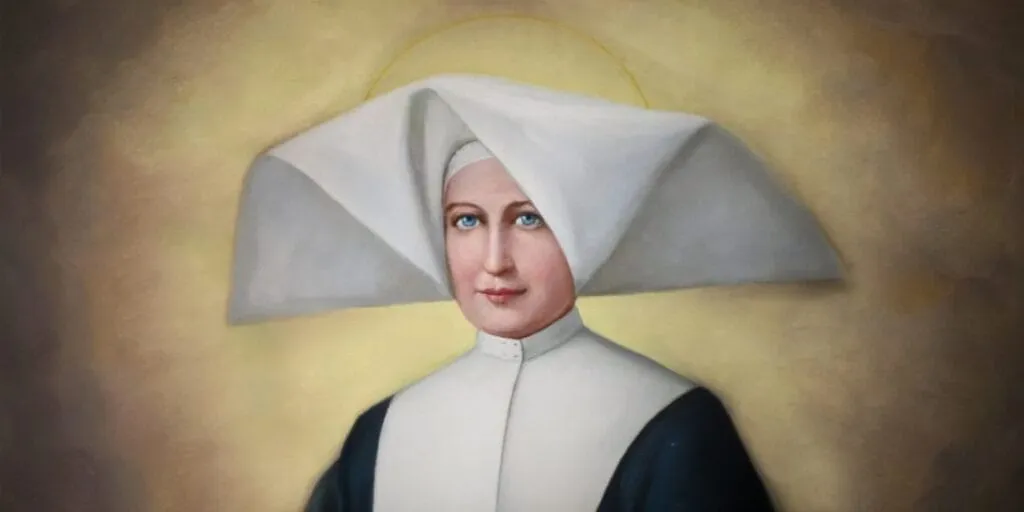
Read the story of Saint Catherine Labourè
Sow, Seer. (1806-1876)
Virgin of the Daughters of Charity
The liturgical feast, for the Vincentian Families, is set for November 28 while the universal one is on December 31.
Caterina, born Zoe Catherine Labourè, was born in France, in Fain-lès-Moutiers, a village in Burgundy, on May 2, 1806, to Pietro and Luisa Maddalena Gontard. Orphaned by her mother at the age of nine with seven brothers and two sisters, Caterina could not attend elementary classes but had to make herself useful in the family and, later, take the reins.
At the age of 12, on January 25, 1818, he made his first Communion. At the time of adolescence, after the appearance in the dream of S. Vincenzo de’ Paoli, who invited her to join her nuns, asked to enter a house of the Daughters of Charity.
On April 21, 1830, Catherine entered as a Postulant among the Daughters of Charity (a sister had preceded her in 1818) in Chatillon-sur-Seine. She was later sent to Paris for the novitiate, in the Mother House located on Rue du Bac. During his noviciate he had other visions, such as those of the Eucharistic Jesus and Christ the King (June 1830).
The apparitions that had the greatest resonance were those of the Immaculate Conception of the “Miraculous Medal”: June 18 and November 26, 1830 (for more details, read the recurrence of November 27 >>> Blessed Virgin of the Miraculous Medal). The Marian message was simple, predisposing to the proclamation of the dogma of the Immaculate Conception (Blessed Pius IX – Giovanni Maria Mastai Ferretti, 1846-1878 – December 8, 1854) teaching a simple and essential prayer: “O Mary conceived without sin, pray for us who we res to you”.
Caterina then felt the invitation: « Have a medal coined on this model; the people who wear it around their necks will receive great graces. The graces will be more abundant for the people who will carry her with confidence» and finally she was assured of the protection of Mary on the Vincentian family that came out painfully tried from the revolutionary and Napoleonic era.
Caterina confided her secret to the confessor P. Giovanni Battista Aladel who spoke about it to the archbishop of Paris, Mons. Giacinto De Quélen, who authorised the coining of the medal: the first came out in June 1832. In ten years, 100 million medals were minted and spread, which immediately crossed the borders of France and was popularly called the “Miraculous Medal”.
Caterina, except for the few superiors to whom she had to manifest what had happened, closed herself in the greatest reserve and remained in the shadows for the rest of her life. After the novitiate, on January 20, 1831, he wore the dress of the Daughters of Charity and on May 3, 1835 he pronounced his first vows.
She was sent to carry out her mission in the Reuilly Nursing Home, dedicated to the Duke of Enghien. Here she remained there until the end of her days serving with maternal care the poor, the elderly, the sick in the various tasks that were entrusted to her.
Having seen the Madonna was never an opportunity for boast, but of commitment and stimulation. At the end of his life he will say: “I was only a tool. It’s not for me that S. Virgin has appeared, but for the good of the Company and the Church”. There was nothing flashy in his existence: he practised the Christian virtues and those of the consecrated woman in a humble and strong, simple and heroic way, reaching a high degree of holiness in daily life and in the service of the poor in whom he saw the face of Christ.
The years were felt as well as the various ailments, from which he suffered, worsened. He died with great serenity of spirit on December 31, 1876.
In 1896 the diocesan process opened and in 1907 the cause of beatification and canonisation was introduced in Rome.
She was beatified by Pp Pius XI (Ambrogio Damiano Achille Ratti, 1922-1939) on May 28, 1933 and canonised by the Venerable Pius XII (Eugenio Pacelli, 1939-1958) on July 27, 1947.
When his body was exhumed, the hands, which had touched the Madonna, and the eyes, which had seen it, appeared extraordinarily preserved; his relics rest in the chapel where he made the apparitions.
Meaning of the name Caterina: “pure woman” (Greek).

For further information:

fonte © Vangelodelgiorno.org