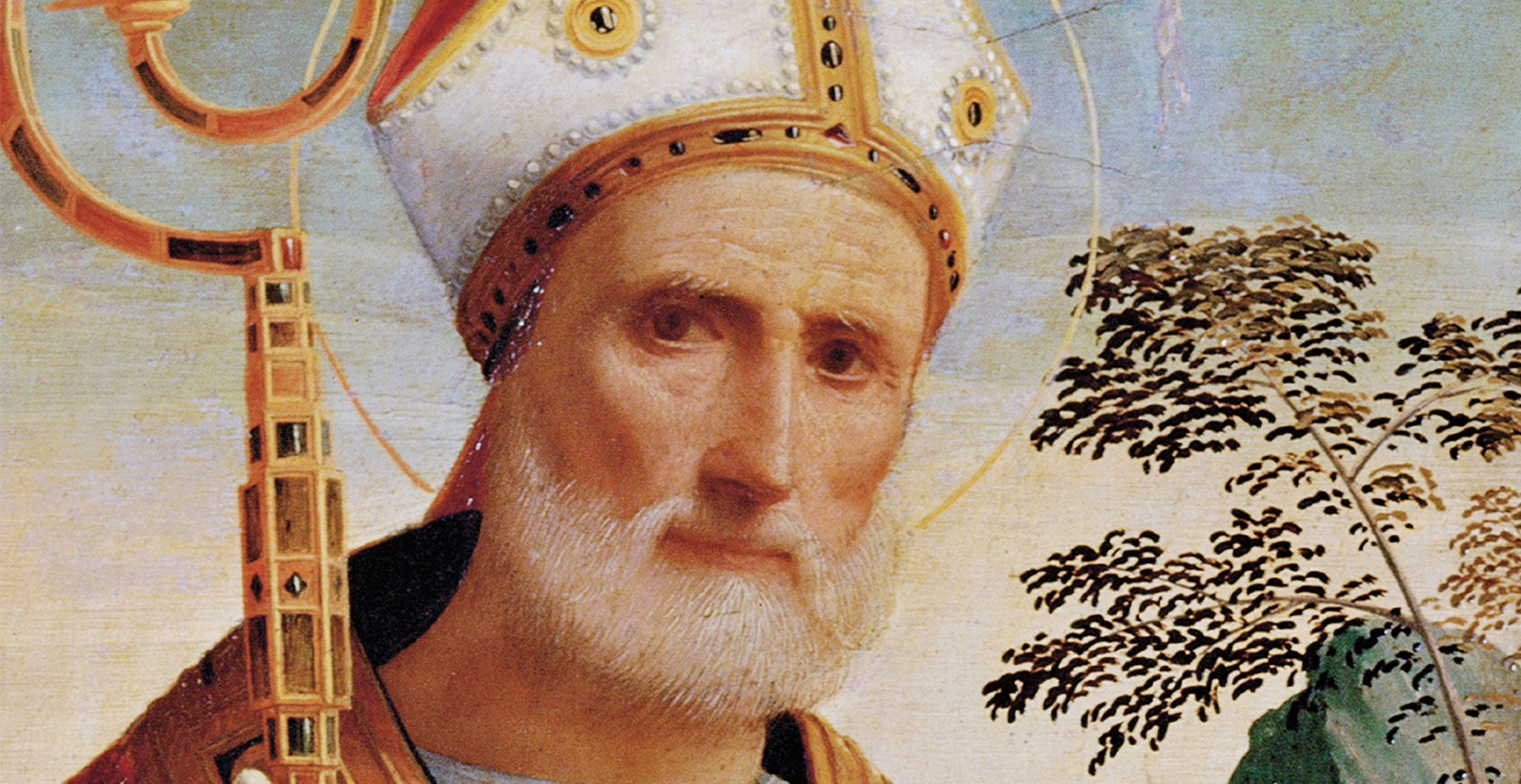

Saint Nicholas of Bari, Bishop of Myra
Saint Nicholas is one of the most popular and beloved Saints, due to the tradition that holds him as the Patron Saint of children and young people. His feast day falls on December 6th.
An Obedient Life
Nicholas was born in Patara, a maritime town in Lycia, in southern Turkey, in the 3rd century AD to a wealthy family who educated him in Christianity.
His life, from his early youth, was marked by obedience. Orphaned of both parents at a very young age, Nicholas, mindful of the evangelical passage of the Rich Young Man, used his entire paternal inheritance to assist the needy, the sick, and the poor. He was elected Bishop of Myra and, under Emperor Diocletian, was exiled and imprisoned.
After being freed, he participated in the Council of Nicaea in 325 and died in Myra on December 6, 343. Many episodes have been handed down about Nicholas, and they all testify to a life of service to the weakest, the youngest, and the defenseless.
Defender of the Weak
One of the oldest stories handed down about Saint Nicholas concerns a neighbor who had three marriageable daughters but not enough money to secure a dowry for them. To save them from a destiny of prostitution, Nicholas, one night, gathered money in a cloth, threw it through the neighbor’s window, and immediately fled so as not to be recognized.
Thanks to that gift, the neighbor managed to marry off his eldest daughter. The mysterious benefactor repeated his generous gesture two more times, but on the third night, the girls’ father came out in time to recognize the mysterious benefactor, who, however, implored him not to reveal anything to anyone. Another story tells of three young theology students traveling to Athens.
The innkeeper where they had stopped for the night robbed and killed them, hiding their bodies in a barrel. Bishop Nicholas, also traveling to Athens, stopped at the same inn and had a dream vision of the crime committed by the innkeeper. Gathering in prayer, Saint Nicholas obtained the miracle of the three boys’ return to life and the conversion of the wicked innkeeper.
This episode, like that of the miraculous liberation of Basil, a boy kidnapped by pirates and sold as a cupbearer to an emir (legend has it that he mysteriously reappeared at his parents’ house with the foreign sovereign’s gold cup still in his hands), contributed to the spread of Nicholas’ patronage over young people and children.
Protector of Mariners
During his younger years, Nicholas embarked on a pilgrimage to the Holy Land. Walking on the same paths trodden by Jesus, Nicholas prayed to have an even deeper experience of closeness to the life and sufferings of Jesus.
On the way back, a terrible storm broke out, and the ship risked sinking. Nicholas quietly gathered himself in prayer, and the wind and waves suddenly calmed, much to the astonishment of the sailors who feared shipwreck.
Saint Nicholas of Bari
After the death of Saint Nicholas, his tomb in Myra soon became a pilgrimage destination, and his relics were immediately considered miraculous due to a mysterious liquid, called the Manna of Saint Nicholas, which flowed from them.
When Lycia was occupied by the Turks in the 11th century, the Venetians tried to seize them, but they were preceded by the people of Bari, who brought the relics to Puglia in 1087. Two years later, the crypt of the new church, desired by the people of Bari on the site where the palace of the Byzantine *catapano* stood, was completed, and Pope Urban II, escorted by the Norman knights, lords of Puglia, placed the Saint’s relics under the altar where they still lie today.
The translation of Saint Nicholas’ relics had an extraordinary echo throughout Europe, and in the Middle Ages, the sanctuary in Puglia became an important pilgrimage destination, resulting in the spread of the cult of Saint Nicholas of Bari (and not of Myra).
Santa Klaus
In the Netherlands and generally in the Germanic territories, the winter feast of Saint Nicholas (in Dutch “Sint Nikolaas” and later “Sinteklaas”), and particularly his protection of children, gave rise to the children’s tradition of awaiting gifts: on the eve of the Saint’s feast, children leave shoes or stockings on a chair, or next to the fireplace, and go to sleep confident that they will find them filled with sweets and presents in the morning.
fonte © Vatican News – Dicasterium pro Communicatione
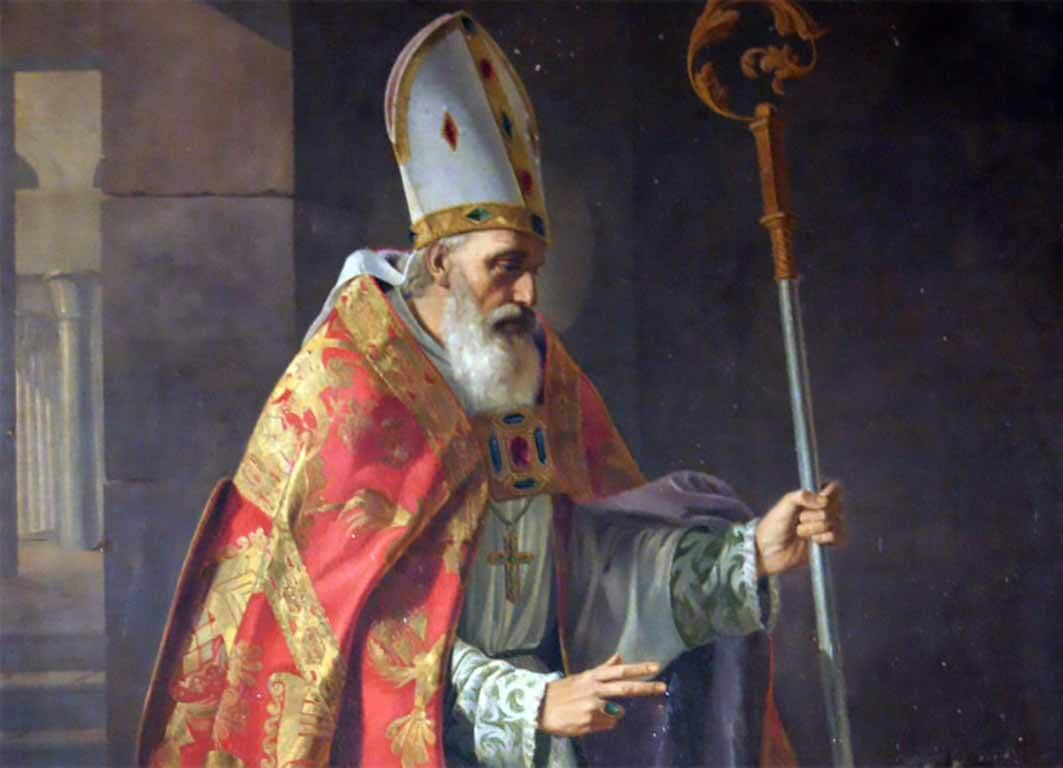
Nicholas was probably born in Patara of Lycia, in Asia Minor (modern-day Turkey), between 260 and 280, to Epiphanius and Joanna, who were wealthy Christians. He was thus raised Christianly, but prematurely lost his parents due to the plague.
He thus became heir to a rich inheritance which he used to help the needy. It is narrated that Nicholas, upon learning of a wealthy man who had fallen into ruin and wanted to steer his three daughters toward prostitution because he could not provide them with a proper marriage, took a good amount of money, wrapped it in a cloth, and threw it into the man’s house at night, allowing him to honestly marry off his daughters.
He subsequently left his hometown and moved to Myra where he was ordained a priest. Upon the death of the Metropolitan Bishop of Myra, he was acclaimed by the people as the new bishop.
Another legend does not refer to the daughters of the ruined rich man, but narrates that Nicholas, already a bishop, resurrected three children whom a wicked butcher had killed and put under salt to sell their meat. Because of this episode too, St. Nicholas is venerated as the protector of children.
Imprisoned and exiled in 305 by Diocletian, he was later freed by Constantine in 313 and resumed his apostolic activity. It is not certain that he was truly one of the 318 participants in the Council of Nicaea in 325, during which he allegedly harshly condemned Arianism, defending the Catholic truth, but legend has it that in a moment of impulse he slapped Arius. The writings of St. Andrew of Crete and St. John Damascene confirm Nicholas’ orthodox faith.
Nicholas also took care of the welfare of his fellow citizens, obtained supplies during a famine, and obtained a reduction in taxes from the Emperor.
He died in Myra on December 6, presumably in the year 343, perhaps in the Monastery of Sion, and even then he was said to perform miracles; this conviction was consolidated after his death, with the great number of legends that widely spread in the East, in Rome, and in Southern Italy.
His remains were preserved with great popular devotion in the cathedral of Myra until 1087. Great is the veneration paid to him by Orthodox Christians.
When Myra fell into Muslim hands, Bari (at the time a Byzantine dominion) and Venice, which were direct rivals in maritime trade with the East, entered into competition for the smuggling of the saint’s relics to the West.
A Bari expedition of 62 sailors, including the priests Lupo and Grimoldo, which set off with three ships owned by the shipowners Dottula, reached Myra and seized Nicholas’ remains, which arrived in Bari on May 9, 1087: Nicholas of Myra thus became Nicholas of Bari. After a temporary placement in a city church, on September 29, 1089, Nicholas’ remains found their definitive location in the already prepared crypt of the basilica being erected in his honor.
It was the Pope in person, Blessed Urban II (Otto of Lagery, 1088-1099), who laid them under the crypt’s altar.
Since then, St. Nicholas became the patron saint of Bari, and the dates of December 6 (the day of the saint’s death) and May 9 (the day the relics arrived) were declared public holidays for the city.
St. Nicholas is also famous outside the Christian world because his figure gave rise to the myth of Santa Claus (or Klaus), known in Italy as Babbo Natale.
Meaning of the name Nicholas: “victor of the people” (Greek).
fonte © vangelodelgiorno.org