



Does Thinking of Oneself First Truly Mean Saving Oneself? The Power that Frees
Commentary on the Gospel of the Day, November 23, 2025
Our Lord Jesus Christ, King of the Universe
Lord, remember me when you come into your kingdom.
From the Gospel according to Luke
Lk 23:35-43
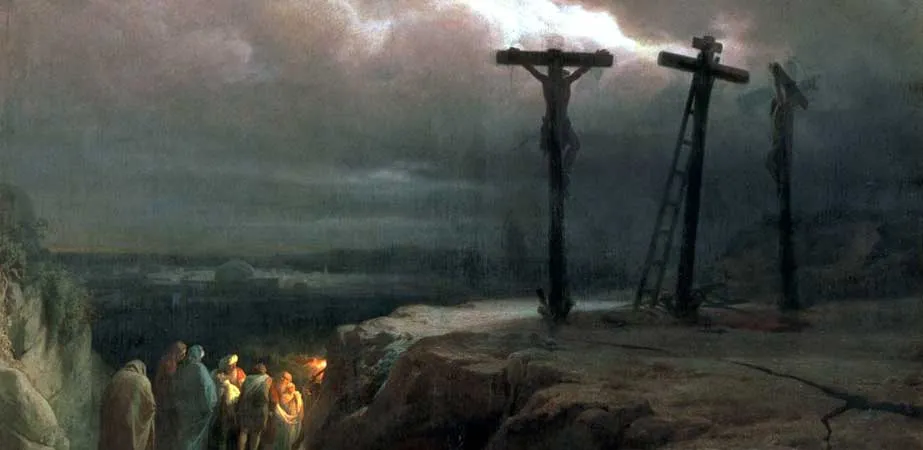
At that time, [after they had crucified Jesus,] the people stood by, watching; but the leaders sneered at Jesus, saying, «He saved others; let him save himself if he is the Messiah of God, his chosen one!»
The soldiers also mocked him, coming up to offer him sour wine and saying, «If you are the King of the Jews, save yourself!» Above him there was also an inscription: «This is the King of the Jews.»
One of the criminals who were hanging there derided him, saying, «Are you not the Christ? Save yourself and us!» The other, however, rebuking him, said in reply, «Have you no fear of God, as you are under the same sentence of condemnation? And indeed, we have been condemned justly, for the sentence we received corresponds to our deeds; but this man has done nothing wrong.»
Then he said, «Jesus, remember me when you come into your kingdom.» He replied to him, «Amen, I say to you, today you will be with me in Paradise.»
The Gospel of the Lord.
The Verb ‘To Save’
What do we think of when we conjugate the verb ‘to save’? In common language, we often use this verb: for example, we rush to save our documents on the computer or external memory, we are comforted when our team saves itself by avoiding relegation, we were saved when we were unprepared and the professor questioned someone else instead of us! It seems, therefore, that in common language, saving means managing to keep things under control, avoiding ruining one’s image, it means not failing and overcoming trials. In general, then, saving for us means being masters of our own lives, having power, sometimes linked to our own abilities, sometimes linked to our role, sometimes simply to chance being favorable to us.
The Temptation of Self-Salvation
However, if we look at how Jesus interpreted this verb, we notice a certain distance from our usual perspective. And this different way of defining salvation also allows us to understand his kingship differently.
While he is on the cross, in fact, everyone urges him to save himself. An invitation that perhaps reminds us of what our mothers used to tell us when we were little: think (first) of yourself!
Save yourself means do not lose yourself, do not fail, show what you are worth! In the race of life, we try to save ourselves first. It is the competition we learn from an early age: we are programmed to save ourselves, even at the expense of others. We must always prove that we are not inadequate.
Luke’s text tells us that the people stood by, watching. This is what always happens: we are surrounded by expectations, prejudices, and anticipations, to which we subject ourselves, and gazes that we try to please. And so we clearly understand that the desire for salvation no longer leads to being king of one’s own life, but becomes anxiety for salvation that makes us slaves to our ego, our image, and judgment.
Whom to Save?
Jesus is King because he defines this verb differently: Jesus is not obsessed with his own ego, he is not a slave to the expectations of others, but he is concerned first and foremost with saving others. He does not put himself before others. If we go back to when Jesus met the temptation that suggested he turn stones into bread (cf. Mt 4:1-11; Lk 4:1-13), that is, to think of his legitimate hunger, Jesus refused; he would eat with others, together with others. Jesus is King because he is not a slave to his own ego, he is the free man par excellence!
Indeed, on that occasion, the tempter had said he would return at the opportune time (Lk 4:13). He returns in fact at the moment when Jesus is weakest: in the passion, in the suffering, in abandonment, in disappointment. And at the most difficult moment, the temptation returns precisely in the form of self-salvation. In moments of difficulty, in fact, we are led to think first of all of ourselves: we become slaves to the worries of our ego.
Allowing Oneself to be Saved
The image of kingship is not particularly effective in our culture, because it either brings us back to the fairy tales we heard as children or takes us back to moments in history that we consider outdated. The figure of the King is often associated with power managed arbitrarily or undeservedly, or power obtained by force.
On the other hand, it is true that we are always looking for a king in our lives, as the text from the Second Book of Samuel also demonstrates: we are looking for someone to delegate power over our lives to. Jesus, however, wants no delegation; he goes to sit on a throne called the cross, after giving his life for us. His power is that of love: the ability to always forgive completely, the strength to love everyone as they are.
Always Possible
In the end, he is not found sitting among the powerful, nor even among his disciples, but among sinners. He made himself so close to sinners that he died among them. His final word is once again a word of welcome: «today you will be with me in Paradise.» That repentant thief is the man who did not succeed in life, one who perhaps wanted to be better, who perhaps tried not to make mistakes, one who could not free himself from the mask of the wicked. Precisely for this reason, his story teaches us that salvation is always possible, even when it seems to us that there is no way out!
Reading Within Oneself (Self-Reflection)
- Do you also try to save your image at all costs, even at the expense of others?
- Are you free to hand over your life to the Lord, or are you a slave to the expectations of others?
Per gentile concessione © ♥ Padre Gaetano Piccolo SJ
Let us Listen Together