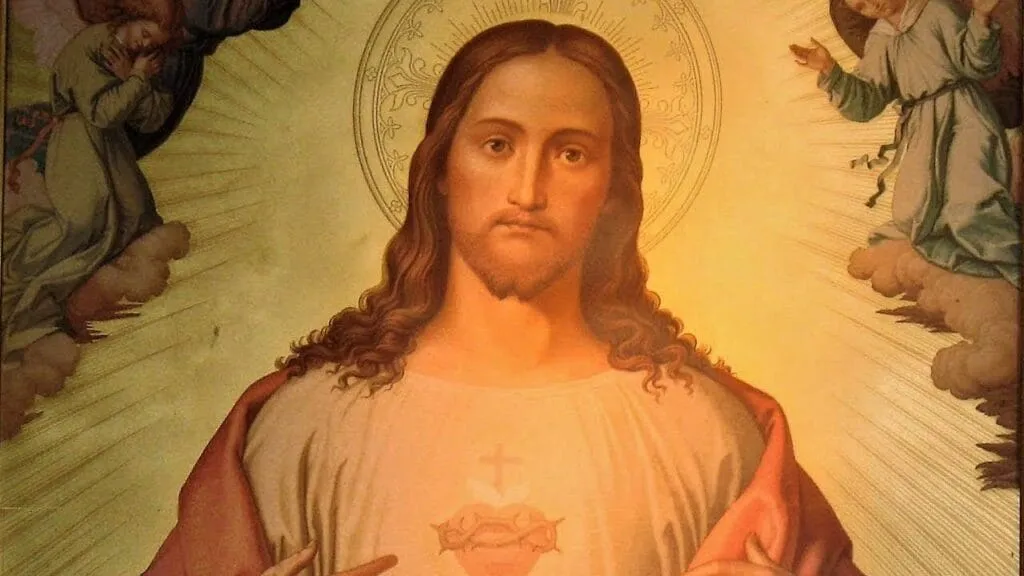

Liturgical Feast of the Nativity of the Lord
From the very beginning, Christians celebrated what the Lord Jesus had accomplished for the salvation of humanity. They did so every Sunday, in the "weekly Easter," and as an annual feast, on the Sunday after the first full moon of spring, Easter. With the beginning of the 4th century, the liturgical calendar began to change, also giving value to the "historical" experience of Jesus: Good Friday to remember the death of Jesus, and then the Last Supper... and in this dynamic, Christmas, the birth of Jesus, of which we have the first testimony in 336, followed shortly after by the Eastern Christmas feast of Epiphany on January 6th. The date was linked to the pagan civil feast of the "birth of the unconquered sun" (Natalis Solis Invicti) which Emperor Aurelian had introduced in 274 in honor of the Syrian sun deity of Emesa, fixed precisely on December 25th. The solemnity of Christmas is the only celebration with four Masses: that of the vigil, the night, the dawn, and the day, and the texts are the same for all three liturgical years. A choice that aims to deepen and value, almost in slow motion, the Event that changed the course of history: God became man.
Vigil: The genealogy of Jesus Christ the son of David, the son of Abraham… Matthan became the father of Jacob, Jacob the father of Joseph, the husband of Mary. Of her was born Jesus who is called the Messiah (Mt 1:1-25).
Night: “Do not be afraid; for behold, I proclaim to you good news of great joy that will be for all the people. For today in the city of David a savior has been born for you who is Messiah and Lord. And this will be a sign for you: you will find an infant wrapped in swaddling clothes and lying in a manger” (Lk 2:1-14).
Dawn: When the angels went away from them to heaven, the shepherds said to one another, “Let us go, then, to Bethlehem to see this thing that has taken place” … They went in haste … Then the shepherds returned, glorifying and praising God (Lk 2:15-20).
Day: In the beginning was the Word, and the Word was with God, and the Word was God … And the Word became flesh and made his dwelling among us (Jn 1:1-14).
Today the Light has entered the world. Today, as has happened for more than two thousand years, the Light pierces the darkness of the night and illuminates us.
That Light has a face and a name for us: Jesus Christ, foretold by the prophet Isaiah: “The people who walked in darkness have seen a great light” (Christmas Midnight Mass, Is 9:1-6).
He is the Light of the world that illuminates the darkness (Jn 1:9; 3:19. Gospel of Christmas Day); He is the Hope that does not disappoint (Rom 5:5); Jesus, the root and offspring of David (cf. 2 Sam 7:8ff, God’s promise to King David (4th Sunday of Advent; Rev 22:16); Jesus is the bright morning star (Rev 22:16).
The Event

This is Christmas. A Fact, an Event that was capable of changing the course of history.
God became man simply to make us children of God (cf. Saint Irenaeus).
An Event so important, so decisive that the liturgy itself has chosen to let us savor it almost in slow motion, offering us not one but four Christmas Masses: the Vigil Mass (around 6:00 PM), the Midnight Mass (usually between 9 PM and midnight), the Dawn Mass (between approximately 7 AM and 9 AM), and the Day Mass (between approximately 10 AM and 6 PM).
Four Masses to savor all the joy of this Event that surprised/disrupted human plans. This is the joy of Christmas: “Today in the city of David a savior has been born for you who is Messiah and Lord” (Lk 2:11, midnight gospel). The Lord Jesus draws near to us to tell us not to be afraid, to break the indifference toward one another, because God, in Jesus His Son, has committed Himself to humanity wounded by sin simply to save us.
Historical Details
The text of Luke, which we hear in the Midnight Mass, is rich in chronological and historical details:
“In those days a decree went out from Caesar Augustus that the whole world should be enrolled… This was the first enrollment, when Quirinius was governor of Syria…” (Lk 2:1-2).
Details that might leave us indifferent because we are so eager to get to the news that Jesus is born; but these are not minor details, because they indicate that the birth of Jesus does not belong to “fables” but to a fact fully inserted within history.
Family Tree

Just as indicative is the Vigil gospel, which inserts Jesus into a family tree that is not exactly perfect, given the characters: yet, He accepts to enter into this family history, which certainly does not shine with saints.
In the long list, the patriarchs are named, then the kings before and after the Babylonian exile. Faithful kings and other idolaters, immoral ones, and murderers. And what about King David, in whom faithfulness to God, sins, and crimes are intertwined (let us only remember the crime he confessed in Psalm 51, after having Uriah killed). The genealogy aims to testify-confirm that Jesus is of the “lineage of David” (cf. Mt 1:6ff), and that the promise God made to David to build him “a house” (cf. 2 Sam 7, 4th Sunday of Advent) found fulfillment in Jesus.
The genealogy shows that one is part of a larger story, and this applies to the man Jesus, the One who inaugurates a new story. Behind every name, though sometimes enigmatic, there is nonetheless a story through which God made something possible. A page that reveals that behind every face there is God’s election and his promise: so it was then and so it is today.
We too have been “chosen” by God’s grace: “It was not you who chose me, but I who chose you” (Jn 15:16). Not chosen for our merits, but for His mercy: “With age-old love I have loved you” (Jer 31:3). This is our certainty: “The Lord called me from birth” (Is 49:1).
And as in the past, so also today Jesus enters into this history and invites us to look beyond, invites us to read this particular historical and social time not with the defeatist litanies of complaint, but with that Light that comes from above and illuminates everything.
After all, even Joseph and Mary did not find themselves in a comfortable context, and yet…
The Manger
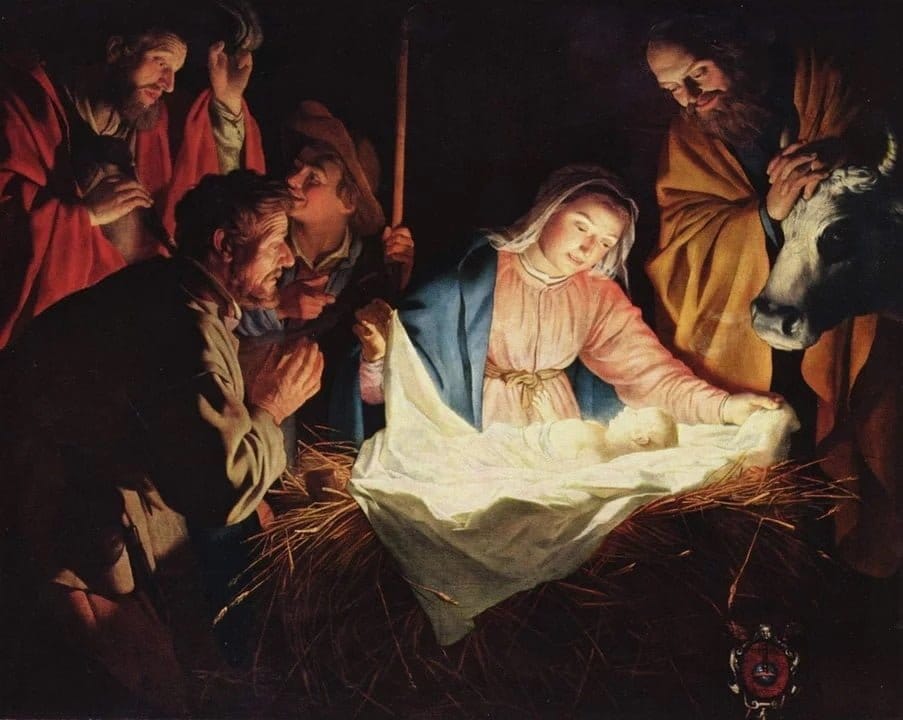
“The time came for her to have her child, and she gave birth to her firstborn son. She wrapped him in swaddling clothes and laid him in a manger” (cf. Lk 2:7, Midnight Mass). God the Father, the Almighty, through Mary, places a Child in a manger, Emmanuel, God-with-us. A Child who begins/archè a new Kingdom, a new History of salvation: a kingdom of justice and peace, of love and truth.
“She laid him in a manger”. The Greek verb indicates the position of those who eat, almost reclining like Roman soldiers. But the baby Jesus is laid in the animals’ trough: it is a receptacle for insects, animal droppings, and dirt. A beginning that suggests how Jesus’ entire life will be like this: angels sing in heaven and a king will persecute him; one day he will be acclaimed by the people and the next day he will be condemned by the same crowd. One day made king and the next nailed up as a criminal. Rejection and glory will be the signs that distinguish this Child.
But there is also another detail often shown in icons. That Child is placed where the animals feed. That Child, who needs to be nourished to grow, is from the beginning celebrated as the “bread” that nourishes: “Do this in memory of me”.
This Child, in these details, reveals to us who He is, but at the same time, reveals to us the path for our own good living. In a time when man is a slave to his own superficial appetites, Jesus points to a new life capable of bringing order to the many disordered appetites that satisfy nothing but one’s own craving to delude oneself into “being like God,” of self-assertion/emancipating oneself from God, consequences of original sin: “The woman saw that the tree was good for food, pleasing to the eyes, and desirable for gaining wisdom; she took some of its fruit and ate it; and she also gave some to her husband” (Gen 3:6).
In being in the manger, Jesus teaches us to nourish ourselves with what matters so that from compulsive eaters we learn to become “bread that gives itself”. It is enough to remember that the first of Jesus’ temptations in the desert focused precisely on the concept of “food”: “Command these stones to become loaves of bread… One does not live by bread alone, but by every word that comes forth from the mouth of God” (Mt 4:3-4), thus showing the style to be adopted.
The Swaddling Clothes
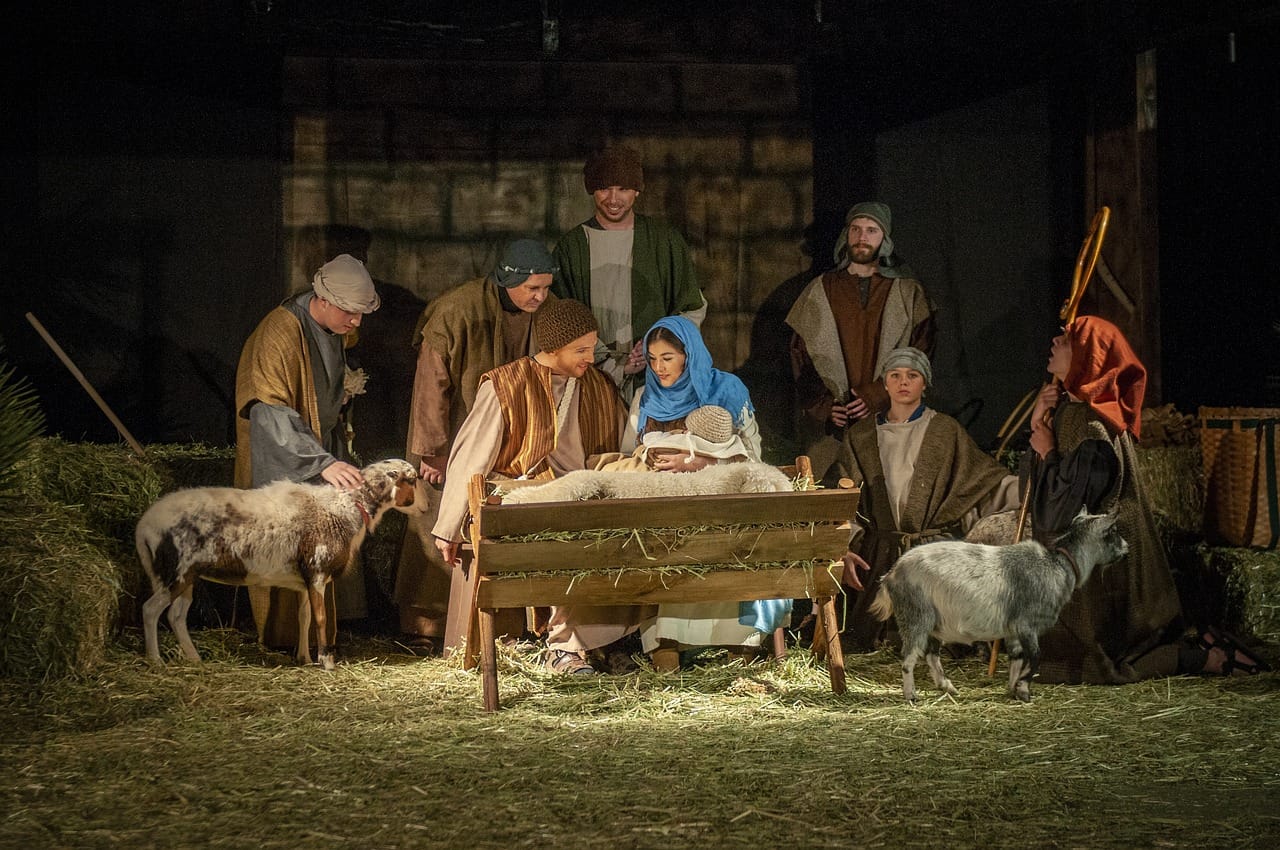
Mary “wraps” the Child “in swaddling clothes”: Mary, even in precariousness, is organized.
This suggests that we learn to “organize ourselves” so that the Child who asks to be born in our hearts, in our lives, finds welcome, care, and protection. In other words, we can say that the memory of the Birth of our Lord illuminates the “daily births” where faith – that is, friendship with the Child Jesus – asks to be welcomed and kept in the “swaddling clothes” of our attention and care, so that it is not debased. In that “infant wrapped in swaddling clothes and laid in a manger,” we are invited to see the logic with which God acts and from which we must learn to act “like God.”
We are invited to invert our logic, our strategies: we are asked for a change of mentality and perspective. It is not what is large and important that counts, but what is small and apparently insignificant: from large to small, from strength to weakness, from power to gift, because that is how God acts! We too, as Christians, are called to be a discreet “sign” of the power of God’s love, a humble instrument of the Lord’s Kingdom, certain that “the weakness of God is stronger than human strength” (cf. 1 Cor 1:25). The term “sign” should not be understood as weakness or surrender, because if “salt loses its taste… it is no longer good for anything but to be thrown out” (cf. Mt 5:13).
My and our being Christians should become that living and credible reminder of the grain of wheat that bears fruit; a “sign” of that Child of Bethlehem, Jesus, here and now. A living and acting capable of showing “Christmas” joy, for a Life given from Above capable of “breaking” itself for others out of love (see Easter).
The Shepherds
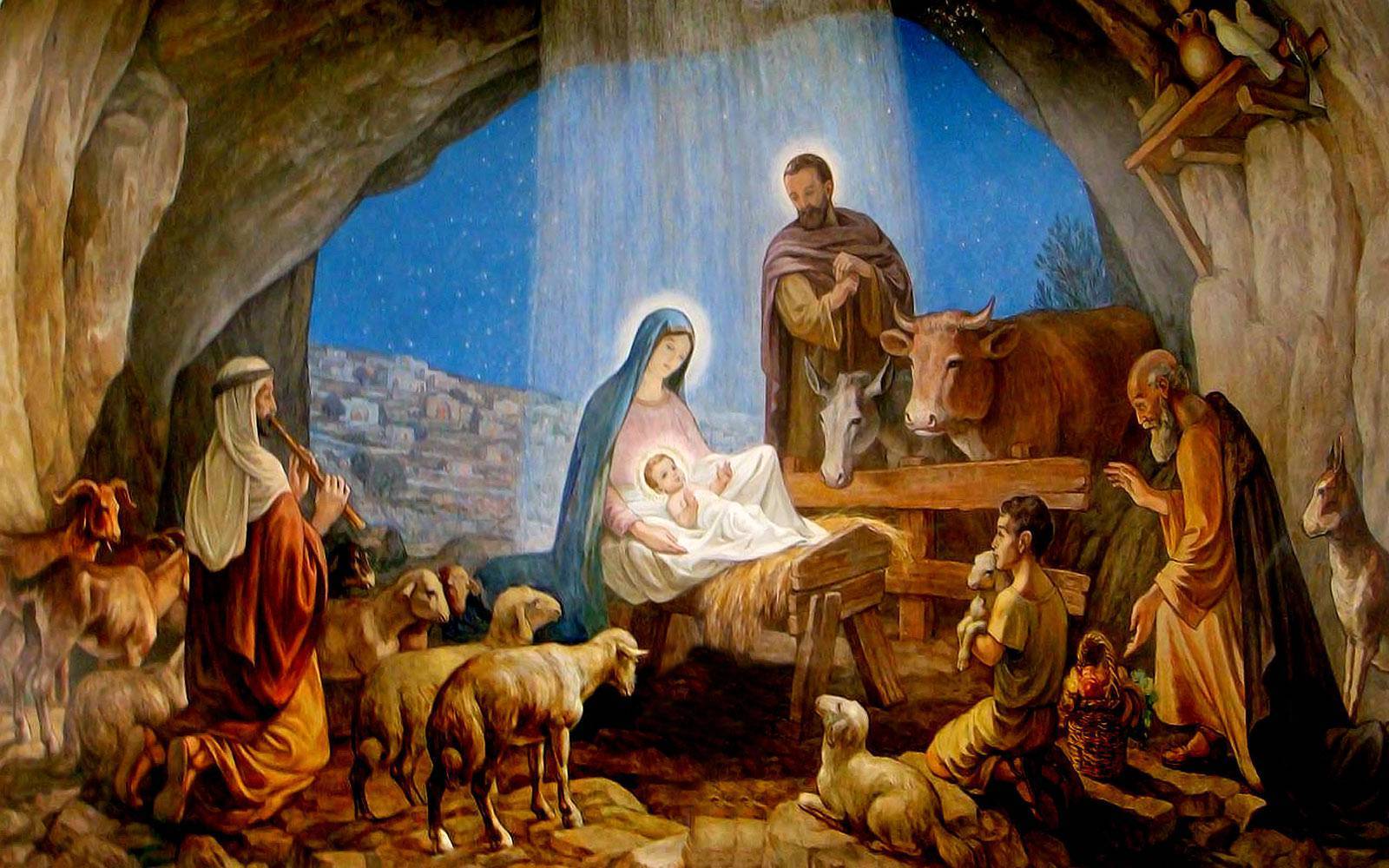
God’s entry into history occurs through “secondary doors” and unconventional methods, so much so that even the angels bring the announcement to the shepherds, not to the priests at the temple. The shepherds were poor guardians paid to watch over the sheep.
Excluded from the people because they were nomads, because they were in contact with people not belonging to the people, foreigners, and therefore impure by the law. And the angels bring the announcement to them first. He entrusts to them first the task of worshipping and going to announce: “Let us go, then, to Bethlehem to see this thing that has taken place, which the Lord has made known to us… They went in haste and found Mary and Joseph, and the infant lying in the manger… The shepherds returned, glorifying and praising God…” (Lk 2:15-20, Gospel of the Dawn Mass).
In those shepherds, nomads who like Jesus do not know where to lay their head (Mt 8:20), we can see the nomadic guardians of our heart, that restless part of us that watches, that seeks, that waits for Someone but often gets its nourishment wrong, deceiving the true hunger and thirst of the heart. After all, each of us is that shepherd who tries to follow his poor things, and when he believes he has arrived, he realizes that the journey is not over.
Christmas

The Nativity of our Lord Jesus reminds us that God is present in all situations where we believe Him to be absent or where we believe He cannot be.
This faith pushes us to look at this time with greater serenity and hope: God is here, so present that perhaps, indeed I am certain of it, He is asking us to review our habits.
He invites us to remember that just as He came to save us, so also we, in Him, can only save ourselves if we walk together, if we learn to take care of one another. We are invited to become a “manger,” where others can nourish themselves on the bread of friendship, love, mercy, and hope. The Lord offers Himself to us so that we may carry Him with the witness of our lives.
As Christians, we are invited to take charge of the hope of this humanity that is so disoriented and alone, to become sentinels of the new morning… so that the darkness of this time may be pierced by the Light that comes from the Lord Jesus, who is the Lord Jesus.
Jesus, Decisive Reality of Existence
He is the decisive reality of my and our existence.
In the Lord Jesus, who has drawn near to us, we learn to become brothers all to share an interior solidarity and closeness that is the most precious thing, being able also to praise together with the angels and say: “Glory to God in the highest, and on earth peace to those on whom his favor rests”.